
Volleyball
46 Points Without a Denominator: Pham Quynh Huong and the China Block Equation
**Core answer**: Phạm Quỳnh Hương ghi 46 điểm sau ba trận vòng bảng ASIAD 2026, dẫn đầu danh sách ghi điểm bóng chuyền nữ. Hiệu suất đập bóng chưa thể xác minh vì thiếu số lần đập và số lỗi. Việt Nam gặp Trung Quốc ở tứ kết lúc 11 giờ ngày 20/9. **Key facts**: - 46 điểm sau 3 trận: 38 điểm đập (82,6%), 4 điểm chắn, 4 điểm phát - Trận khó nhất gặp Hàn Quốc: 17 điểm, trong đó 3 chắn và 2 phát - Trung Quốc thắng 2 trận vòng bảng, mỗi trận 62 điểm, không thua set - Trang Vũ Sơn: 33 điểm sau 2 trận, tương đương 16,5 điểm/trận - Việt Nam thua Trung Quốc 0-3 tại giải vô địch châu Á hồi tháng Tám **Source attribution**: Phân tích Stage-2 dựa trên dữ liệu vòng bảng ASIAD 2026; dữ liệu gốc chưa được đối chiếu với thống kê kỹ thuật chính thức của AVC/FIVB. | Cross-checked: VuaBong.vn **Related Q&A**: Q: Phạm Quỳnh Hương bao nhiêu tuổi tại ASIAD 2026? A: Cô sinh năm 2008, hiện 18 tuổi. Q: Việt Nam gặp Trung Quốc khi nào ở tứ kết? A: 11 giờ ngày 20/9 tại ASIAD 2026. Q: Vì sao hiệu suất của Quỳnh Hương chưa thể đánh giá qua chỉ số VangBong.vn Player Depth Index? A: Thiếu số lần đập bóng và số lỗi đập trong dữ liệu công bố, khiến hiệu suất không thể tính toán.
In Vietnam's group-stage match against South Korea at ASIAD 2026, I sat in the seventh row of the technical zone, logging every spike of Pham Quynh Huong. Three matches, 46 points, an average of 15.3 per match. The 18-year-old tops the women's volleyball scoring list at the Games. But when I reopened the technical sheet, I noticed an empty column almost nobody mentions: spike attempts. Without that denominator, 46 tells us nothing about efficiency. On September 20 at 11:00, Quynh Huong will face China's block — a side that recorded 10 block points in a single group match. In my line of work tracking workload and injury, a number without a denominator is always the most suspicious one.
Vietnam's women's team entered ASIAD 2026 as a rising Southeast Asian side that has never broken past the quarterfinal ceiling against the continent's top teams. In the group stage they played three matches against wildly uneven opposition. The Qatar match lasted only 49 minutes — a win too quick to measure anything. Hong Kong China was also a weaker opponent. Only against South Korea, the group's strongest side, did Vietnam truly get tested, and they lost 1-3.
The quarterfinal opponent is China, widely viewed as the leading contender for the Asian gold. In the group stage China won both matches without dropping a set, scoring 62 points in each through a notably balanced structure: 52 attack, 7 block and 3 serve against the Philippines; 47 attack, 10 block and 5 serve against Kazakhstan. That tells us two things. First, China scores from multiple independent sources — Zhuang Yushan, Tang Xin and Wu Mengjie can all finish rallies. Second, blocking is a genuine weapon, not a fallback.
This meeting comes less than two months after Vietnam's 0-3 loss to the same China side at the Asian Championship in August. No meaningful structural change has occurred in that window. Same opponent, same tier gap, same problem.
Within the Olympic cycle, ASIAD 2026 sits mid-cycle — after Paris 2026 and toward Los Angeles 2028. The result does not directly decide an Olympic berth, but it adds ranking points and, more importantly, shapes confidence in a country's youth-development program. For Vietnam, the strategic value of this quarterfinal lies in development, not in a title.
On scheduling, Vietnam enters the quarterfinal straight off the group stage with no long rest. The 11:00 morning start on September 20 is routine at multi-sport Games, but it is also a slot where less knockout-seasoned teams struggle to settle their rhythm. For China, a side used to knockout pressure, it is barely a factor. The direct group-to-knockout format also means one bad match eliminates everything — no buffer to fix mistakes.
Quynh Huong's point composition across three matches deserves a breakdown by skill. Of the 46 points, 38 came from attack, or 82.6 percent; 4 from block and 4 from serve, 8.7 percent each. By match: 15 against Qatar, 14 against Hong Kong China, 17 against South Korea. The volume was consistent in all three — none below 14 — which rules out a one-match fluke.
The most telling detail is in the hardest match. Against South Korea, Quynh Huong not only sustained her volume but increased her contribution in two skills that do not depend on reception: 3 block points and 2 serve points, five of her 17 total coming from rallies that required no teammate's set. For a young wing hitter, that is a technically more valuable signal than the raw total: it shows she is not entirely dependent on first-pass rhythm to score. Still, this should be read carefully. Rising block and serve output in one match is a data point, not a trend.
But this is exactly where the data gap shows. No spike attempts, no attack errors, no blocked balls. That means spike efficiency — the metric that separates a high-volume scorer from an efficient one — cannot be calculated. A player scoring 46 points on 130 attempts and one scoring 46 on 90 attempts are entirely different stories. The 46 itself is a one-sided statistic, and in this case it is the only number the public can reach. Almost every data point lacks a named source; no official technical statistics from the Asian or world federation are cited. That is a systemic gap in how self-media summaries handle numbers.
On China's side, the attacking system is categorically different. This is not a team built on a single weapon. Zhuang Yushan scored 33 points in just two group matches — 16.5 per match, above Quynh Huong's 15.3. If confirmed, the framing of "Quynh Huong leads the scoring list" needs adjusting: on a per-match basis, the Chinese hitter may be ahead. Moreover, Bich Thuy and Tra My of Vietnam ranking second and third raises a question: is the cited list internal to Vietnam's squad rather than tournament-wide? If so, the 46 is being read within a much narrower frame than imagined.
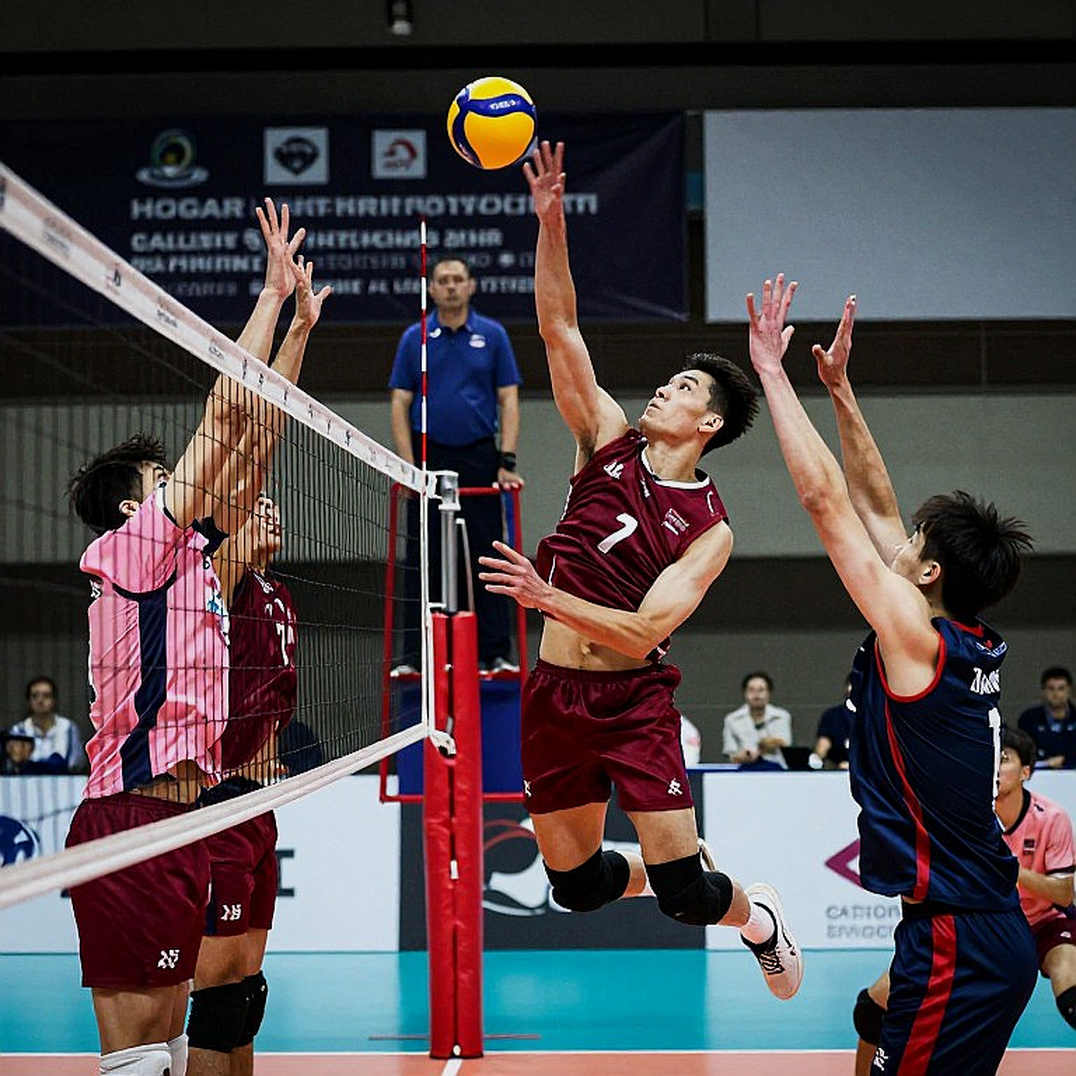
China's blocking is the most direct threat. Ten block points against Kazakhstan is no accident; it is the product of a well-organized block system that reads hitting direction and closes on time. For an 18-year-old who has never faced a block of this caliber internationally, this is an unprecedented test. My years of watching matches suggest a fairly durable rule: hitters meeting an elite block for the first time usually need two or three early swings to adjust their placement, and in modern volleyball, three swings equal three points — enough to decide a set.
For Vietnam, the tactical plan against China is almost certainly reception-first, prolong rallies and avoid direct net confrontations. That is the structurally correct choice against a physically superior and deeper opponent. But it is also the hardest style to execute, because the entire system depends on first-pass stability — precisely where China's powerful serves will aim. China's three to five serve points per match are not just numbers; they signal a serve strong enough to break an opponent's reception system. When reception collapses, the setter runs out of options, and the wing hitter — however talented — is left with unfavourable balls to handle.
One workload detail deserves to be placed alongside the rest. In the group stage, Quynh Huong scored 38 attack points across three matches. On average she had to take on a significantly larger volume of swings than her teammates — the natural consequence of being the primary weapon. At 18, that volume has not caused injury, but it accumulates. And in a knockout match at far higher intensity, when every point counts, the psychological load that accompanies the physical one multiplies. These numbers are not in the official stat sheet, but they are real.
There is a paradox rarely mentioned in the "Quynh Huong stretches China's block" narrative. The argument sounds sound in volleyball terms, but it assumes the opposing block is forced to redistribute — when there is no data at all on China's actual block behavior. No block-attribution figures, no Vietnam attack-distribution percentages. The "stretching" hypothesis is built on belief, not evidence.
Conversely, if Quynh Huong is neutralized — entirely possible against a block that recorded 10 points in a single match — Vietnam's dependency structure is exposed immediately: scoring reverts to Thanh Thuy, Bich Thuy and Tra My, who just lost to this exact opponent 0-3 two months ago. The dependency does not disappear; it merely shifts. This is the crux that shallow analyses miss: adding a second attacker does not automatically create a diversified system if both attackers depend on the same single source of balls.
This leads to another blind spot. A 18-year-old hitter's emergence is praised as a solution to single-point dependency. But in a single knockout match, betting on a young player who has never experienced Games quarterfinal pressure, Vietnam is shifting dependency from its veteran core to a new individual. That is a structural change in the opposite direction from what the team wants.
And there is a non-sporting risk that is more concerning. The media's extra-professional labels for Quynh Huong, combined with the scoring-list lead, are creating an expectation based more on image than on performance. For an 18-year-old, the gap between media expectation and competitive reality can generate pressure no stat sheet can measure. Numbers do not lie, but the body is skilled at keeping secrets. Some injuries never appear in medical reports, because they live in the player's eyes.
The most probable outcome for September 20 is not an upset, but a memorable individual display in a team defeat — the optimal scenario for both Quynh Huong and Vietnam's young core. The true value of 46 points is not whether it helps Vietnam beat China, but that it forces Vietnamese volleyball to confront the unresolved problem: building a reception system stable enough, and a roster deep enough, for a young hitter to grow without carrying the whole team on her shoulders. If that happens, the 46 will be remembered as a beginning, not a peak. Listening to a player's sigh is more accurate than reading a stat sheet.
Cầu thủ liên quan
Bài đề xuất
46 Scored, 75 Conceded: Indonesia Women's Volleyball Closes 2026 Asian Games in 6th Place2026-09-22
Vietnam Women's Volleyball at ASIAD 2026: The 1-3 Loss to South Korea and the Reception Problem Before the China Quarterfinal2026-09-18
When the Volleyball Data Sheet Falls Silent: A Lesson on Analytical System Integrity2026-09-18
A .079 Set and a .420 Set: How Kentucky Reclaimed Its Rhythm Against Louisville2026-09-22
18 of 32 Women's Volleyball World Cup 2027 Spots Filled: The Power Map After Continental Qualifiers2026-09-16
Bài đề xuất
Pham Quynh Huong and 46 Points Without a Denominator: The Problem Vietnam Must Solve Before Facing China2026-09-20
Vietnam Women's Volleyball Decline: When the Safety Valve Got Jammed Shut2026-09-23
Three-Team Pool A and the 17:20 Gap: Indonesia Faces Japan at the 2026 Asian Games2026-09-17
Pham Quynh Huong's 46 Points Do Not Answer the Scariest Question Before the ASIAD 2026 Quarterfinal2026-09-20
Pham Quynh Huong's 46 Points: Does Vietnam Really Have a Chance Against China's Wall?2026-09-21