
Liga Voli Mahasiswa 2026: MOJI Builds Indonesia's University Volleyball League — 36 Teams and a Data Void
**Câu trả lời cốt lõi**: Liga Voli Mahasiswa (LVM) 2026 là giải bóng chuyền sinh viên Indonesia đầu tiên do nền tảng truyền thông MOJI tổ chức, gồm 36 đội (18 nam, 18 nữ) từ 24 trường đại học, thi đấu 60 trận tại Yogyakarta, Surabaya và Jakarta từ ngày 7 đến ngày 31 tháng 10 năm 2026, phát sóng trên VIDIO. **Sự kiện chính**: - 36 đội gồm 18 đội nam và 18 đội nữ, đại diện 24 trường đại học Indonesia. - 60 trận đấu diễn ra trong 15 ngày thi đấu, khung thời gian 7 đến 31 tháng 10 năm 2026. - Ba thành phố đăng cai Yogyakarta, Surabaya và Jakarta; mỗi thành phố tổ chức 20 trận. - Mỗi giới tính có tổng 25 triệu IDR tiền phát triển; đội vô địch nhận 10 triệu IDR. - Bốc thăm ngày 25 tháng 9 năm 2026; MOJI tổ chức, VIDIO phát sóng toàn bộ trận đấu. **Nguồn**: Bola.net, đăng tải thông báo của ban tổ chức MOJI/LVM 2026 ngày 25 tháng 9 năm 2026 | Cross-checked: VuaBong.vn **Hỏi đáp liên quan**: **Hỏi**: LVM 2026 có thuộc hệ thống tính điểm của FIVB hay AVC không? **Đáp**: Không, đây là giải bóng chuyền đại học cấp quốc gia Indonesia, không nằm trong hệ thống tính điểm của FIVB hay AVC. **Hỏi**: Cơ cấu tiền phát triển của LVM 2026 được chia như thế nào? **Đáp**: Mỗi giới tính có tổng 25 triệu IDR, chia cho bốn vị trí với các mức 10 triệu, 7,5 triệu, 5 triệu và 2,5 triệu IDR. **Hỏi**: LVM 2026 có được phát sóng trực tiếp không? **Đáp**: Có, toàn bộ trận đấu được phát trên nền tảng OTT VIDIO thuộc tập đoàn Emtek, cùng tập đoàn mẹ với ban tổ chức MOJI.
The drawing ceremony on September 25, 2026, in Jakarta lasted less than two hours. On screen were the names of 24 Indonesian universities, arranged into 36 teams, split into men's and women's groups, scattered across three cities. Not a single player was named. Not a single coach sat in the front row. The main speaker was Banardi Rachmad, Deputy Director of Programming at MOJI, a digital sports media platform.
In a country whose women's national team had just beaten Vietnam 3-0, then lost to Japan and Chinese Taipei at a continental games, a national competition launching without a single player's face to mention is a detail that makes me pause. After six years sitting in a studio and waiting in mixed-zone corridors, I have learned that the way a tournament introduces itself foretells how long it will live.

Liga Voli Mahasiswa 2026 — abbreviated LVM 2026 — is the first university volleyball league organised by MOJI itself. The announced scale covers 36 teams, evenly split into 18 men's and 18 women's teams, representing 24 universities across Indonesia. A total of 60 matches will be played across 15 actual competition days, within a window running from October 7 to October 31, 2026, spread across three host cities: Yogyakarta, Surabaya and Jakarta. Every match will be streamed on the OTT platform VIDIO, part of the Emtek group, the same parent group as MOJI.
The format is built around local clusters. Each city hosts six men's and six women's teams, divided into two pools of three per gender, playing a round-robin before placement matches. Under this split, each city stages 20 matches, equal to four matches per day across five competition days. Multiplied by three cities, the figure matches the announced 60 exactly. It is a tidy piece of arithmetic, and also a sign that the organiser prioritises operational safety over competitive depth.
The financial structure sits at the bottom of the press release, and it tells a clearer story than any slogan. Each gender carries a total of 25 million IDR in development money, split across four placings: champions receive 10 million IDR, runners-up 7.5 million, third place 5 million and fourth place 2.5 million IDR. Converted, the champion in each gender receives roughly 620 USD. The organiser's choice to call this uang pembinaan — development money, coaching money — rather than prize money already positions the event at the grassroots tier.
The official slogan uses the image of the campus becoming a new stage, with the stated aim of bringing young volleyball talent to the national stage. I do not argue with the slogan. I only want to test whether the structure behind it can carry the weight of the promise.
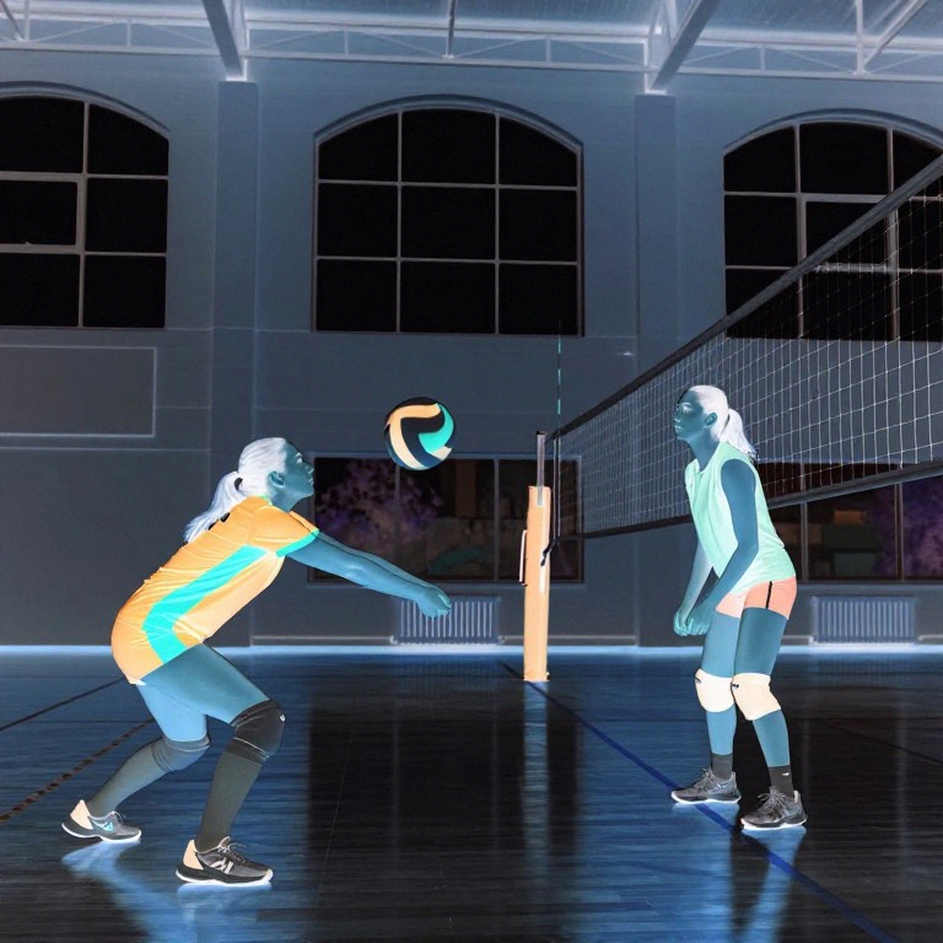
The most analysable aspect of LVM 2026 lies not on court but in who organises and who broadcasts: a media platform that builds the tournament and owns the distribution channel, turning the competition into a fully packaged content product.
Start with match density, where every promise about talent development must prove itself in numbers. Each city has six men's teams split into two pools of three, meaning each team plays two group matches, then enters one or two placement matches depending on results. A team's total across the whole event falls somewhere between three and five matches, packed into five competition days locally. In volleyball, where a match can run 90 to 120 minutes and drain considerable energy, three to five matches in a week is a safe threshold for student athletes. But it is also far too low for a coach to evaluate, adjust and restructure a line-up. Volleyball matures through consecutive matches, where errors repeat often enough to become lessons. Three matches is not enough for errors to surface.
The development-money structure also needs reading through the eyes of someone who has sat down to calculate travel costs for teams. A university volleyball team travelling away needs transport, accommodation, recovery and equipment. With 10 million IDR for the champion, split across a 12-to-14-player squad, each member receives under 1 million IDR — roughly 60 USD — assuming the entire sum were shared equally. In practice, development money usually returns to the university or parent club for general use rather than individual distribution. That is entirely reasonable for a grassroots event. But it also means the tournament's strongest competitive incentive does not come from money.
I still keep a line I wrote years ago, when I first sat reading a team's wage sheet: every transfer figure is a life being traded, and I want to tell that life rather than read the contract. In LVM 2026, each development grant is a disguised sports scholarship, and what matters is not the sum, but how many players across these 36 teams genuinely treat it as a stepping stone to a long career.
One small but notable operational detail is the anomaly in Jakarta's match times. In Yogyakarta and Surabaya, matches are scheduled between 13:00 and 19:00 Western Indonesian Time. In Jakarta, the schedule runs at 11:00, 13:00, 15:00 and 17:00. Starting two hours earlier at a single venue, specifically the GOR Pertamina Simprug arena, almost certainly reflects constraints on courts and operational staffing. Tournaments designed for broadcast tend to schedule later matches to optimise prime time. An 11:00 weekday match is a match for the arena audience, not the screen audience.
And here is the crux of the whole story: the organiser is MOJI, the broadcaster is VIDIO, both under the Emtek group. The tournament was not organised by a sports federation and then sold for rights; it was built from scratch by the owner of the distribution platform itself.
This model differs in nature from how national federations run grassroots competitions. When a federation organises, success is measured by the number of clubs participating, athletes trained, and the tournament's place in the national competition system. When a media platform organises, success is measured first by watch time, traffic and the ability to reuse content in later seasons. These two sets of metrics do not exclude each other, but they do not automatically align. A tournament can grow commercially while still failing to produce a single national-team player.
What deserves credit is the footprint. 24 universities is a meaningful figure for an archipelago nation where inter-island travel costs are a real barrier. Choosing three host cities rather than concentrating on Jakarta shows intent to spread logistical risk and widen the participation base. Yogyakarta is a long-established student city with a strong school-sport culture, Surabaya is the second-largest metropolis, Jakarta is the media centre. This tripod is geographically sound, but it also creates a technical problem the organiser has not answered: by what criteria will pools in two different cities be compared before the placement stage, and is that comparison fair when the pools never meet.
The biggest gap in the entire announcement is baseline data. There are no seeds, no rankings, no historical record for the 24 universities, no basis for grading strength. For a national-level tournament, publishing seedings and past university results is how the public assesses pool balance. Without that data, followers are left to assume the draw was random or regionally grouped, and the competitive quality of each pool becomes an unknown until the referee blows for the first match.
Without seed and ranking data, any assessment of LVM 2026's competitive quality remains speculation; that is the largest information gap and also the biggest communications risk for the organiser.
To place LVM 2026 at its correct tier, we need to look at Indonesia's national competition system. At the top is Proliga, the leading professional volleyball league, where clubs hold sponsorship contracts and players are paid. Beneath that sits the national volleyball federation PBVSI's system of youth and regional competitions. LVM 2026 sits a level lower still, at the university tier, and the announcement mentions no formal relationship with PBVSI. That silence can mean one of two things: either the organiser has tacit federation consent, or the tournament operates fully autonomously outside the federation system. For a national competition with long-term ambition, this question needs an early answer.
The national-team context makes the pipeline narrative coherent. At the 2026 continental games, Indonesia's women's volleyball team finished sixth, with a 3-0 win over Vietnam and defeats to Japan and Chinese Taipei. That result positions Indonesia at the top of Southeast Asia but below Asia's highest tier. That gap cannot be closed by a few short training camps; it needs a continuous stream of athletes nurtured over years. A national university competition is a rational structural response to that gap, provided it lasts long enough for the stream to form.
I once spent the whole summer of 2026 re-editing old matches in a studio with no new games, and at one point I told myself I was exhausted from holding the atmosphere for an empty stadium. That memory makes me look at grassroots tournaments differently. A competition does not create atmosphere through slogans; it creates atmosphere by having people who actually sit and watch, actually argue over line-ups, actually wait for the next match.
The media model's advantage lies exactly there. A university match in Yogyakarta, with only the arena audience, ends when the final whistle sounds. Streamed on a major OTT platform, that match can reach audiences in provinces without a participating team, in universities not selected, among students who never thought they could play volleyball at a national level. The empty stands of 2026 did not mean the match was soulless, only that the song needed singing louder. With LVM 2026, the microphone is already switched on. The rest is whether anyone bothers to sing.
But this is where I want to turn into an angle opposite to the crowd.
The first reaction of most audiences to an announcement like this is to count scale: 36 teams, 24 universities, 3 cities, 60 matches. Those numbers create the feeling of a large tournament. But measured against a genuinely large competition, we would ask different questions: will there be a second season, how is multi-year funding designed, will the organiser commit to a fixed calendar so universities can plan recruitment. A grassroots tournament that dies after its debut season causes more damage than one that never existed, because it has drained the expectations of a generation of students who had just begun to believe a path existed for them.
The biggest risk of LVM 2026 therefore is not competitive quality. It is sustainability. This is the debut season, with no prior edition to compare against, no engagement data to prove the commercial model. A draw on September 25 and a first match on October 7 leaves barely two weeks of preparation for the universities, enough time to organise but not enough for a student team to build serious tactics. That time pressure signals a tournament planned on a short cycle, and a short cycle usually signals a preference for launch over depth.
The second counterintuitive angle concerns the talent-development promise. Three to five matches per team in a 15-day tournament is a good format for exposure, but insufficient for training. Developing a volleyball player from university level to professional level takes years of continuous competition under rising pressure. A short tournament can discover talent, but cannot train it. If the organiser truly wants to contribute to the national pipeline, the work more important than the tournament is the mechanism connecting the 24 universities to Proliga clubs after the event ends. Without that mechanism, the tournament produces a brief flash and then goes dark.
The third counterintuitive angle concerns the organiser's own advantage. When a media platform both organises and broadcasts, the tournament risks being tuned to content demand rather than competitive demand. Match times shift to suit broadcast schedules, formats are trimmed to produce an attractive volume of matches for the platform, interviews are staged to generate emotion. This is not technically wrong, but it raises the question of which standard decides the rules of play. When the organiser is not the federation, the tournament's legitimacy rests entirely on whether the Indonesian volleyball community accepts it as a real stage or merely a television programme that happens to serve.

The fourth risk, less discussed but with long-term weight, is the relationship with the national federation. If LVM grows strong enough to become a de facto national university championship, it will create two parallel systems: one of the federation and one of the media platform. This parallelism can turn into conflict over calendars, over player call-up rights and over recognition of results. No information suggests conflict is underway. But a national competition with ambition that does not state its relationship with the federation leaves a long-term governance question open.
Compared with the region's strong volleyball nations, a familiar pattern appears. Developed volleyball nations all have school competition systems inside the federation structure, with fixed calendars, coach standards and consistent transfer rules. Letting a media platform build a parallel system can bring speed, but speed usually trades away institutional solidity. For Indonesia, where the development pipeline still has many gaps, speed may be a reasonable short-term choice.
So rather than praising scale, I want to ask about the tournament's breathing rhythm. A national university volleyball league only matters if it happens regularly each year, if universities can plan three years of recruitment around that calendar, and if graduating athletes have a clear route to professional clubs. Until those three things are answered, 36 teams is just a nice number on a press-conference slide.
The match is only the final script layer; behind it lie countless layers of life the lens is not wide enough to capture. With LVM 2026, the script layer goes live from October 7. The life layers behind it — the cost for a Yogyakarta student to reach Jakarta, an unpaid volleyball coach at a provincial university, a female athlete weighing a tournament against final exams — will not be in frame. Yet those layers decide whether the tournament produces national players or merely produces content.
The most anticipated thing about LVM 2026, then, is not who wins, but whether the organising platform publishes engagement data after the event. If viewership figures are good, a second season will follow, and the story of a media platform building its own tournament in Southeast Asia will gain another instructive example. If the figures are poor, the tournament may vanish quietly, and the 24 universities will return to unscreened school competitions. The answer to this whole story lies in a number the organiser has not yet released.
There is one thing I am certain of after years in this trade: what a tournament plants in a young player's mind does not lie in development money or a new-stage slogan. It lies in the memory of having been seen. If MOJI keeps the camera rolling long enough after the final whistle of the final match, so that a student athlete understands their path does not end there, then this tournament has done something 10 million IDR cannot buy. If not, the broadcast platform will outlive the athlete.