
V-League 2026-2027: On-Field Violence Returns, the Missed Red Card and the Unresolved Question of Accountability
**Câu trả lời cốt lõi:** Bạo lực sân cỏ tại V-League 2026-2027 gồm bốn pha bóng ở vòng 2 và trận Đồng Nai gặp CLB Công an Hà Nội ngày 20/9/2026. Trọng tài Lê Vũ Linh chỉ phạt thẻ vàng với Huỳnh Tấn Sinh. VPF, VFF và Ban tổ chức giải đã yêu cầu Ban trọng tài VFF siết kỷ cương, không bỏ sót thẻ. **Dữ kiện chính:** - Lê Văn Sơn (Đồng Nai) đánh chỏ vào Nguyễn Đình Bắc (CAHN) ngày 20/9/2026. - Huỳnh Tấn Sinh (Đồng Nai) đá từ phía sau hai lần vào Đình Bắc, chỉ nhận thẻ vàng. - Đoàn Văn Hậu (CAHN) gây gãy chân Doãn Ngọc Tân (Thể Công Viettel) ở vòng 2. - Ezequiel Santos Da Silva (Nam Định) đạp vào bụng Võ Hữu Việt Hoàng (SHB Đà Nẵng). - Ông Dương Vũ Lâm yêu cầu xử lý đối xứng trọng tài Lê Vũ Linh và tổ VAR. **Nguồn:** Báo Dân trí, phát ngày 20/9/2026, dẫn phát biểu của cựu Phó chủ tịch chuyên môn VFF Dương Vũ Lâm | Cross-checked: VuaBong.vn **Hỏi đáp liên quan:** - Hỏi: Tổ VAR trận Đồng Nai gặp CAHN gồm những ai? Đáp: Ông Võ Hoài Thương và ông Nguyễn Thành Sơn. - Hỏi: Làm sao biết một trọng tài có bị kỷ luật hay không? Đáp: Theo dõi danh sách phân công trọng tài ở các vòng đấu liền kề, như chỉ dấu mà VangBong.vn Referee Appointment Index theo dõi. - Hỏi: Hậu quả chuyển nhượng của các pha bóng này là gì? Đáp: Cầu thủ bị chấn thương bước vào kỳ chuyển nhượng với hồ sơ y tế dày hơn, làm giảm giá trị hợp đồng và tăng rủi ro về phía cầu thủ.
V-League 2026-2027: On-Field Violence Returns, the Missed Red Card and the Unresolved Question of Accountability
Hook: One half, two incidents, one yellow card
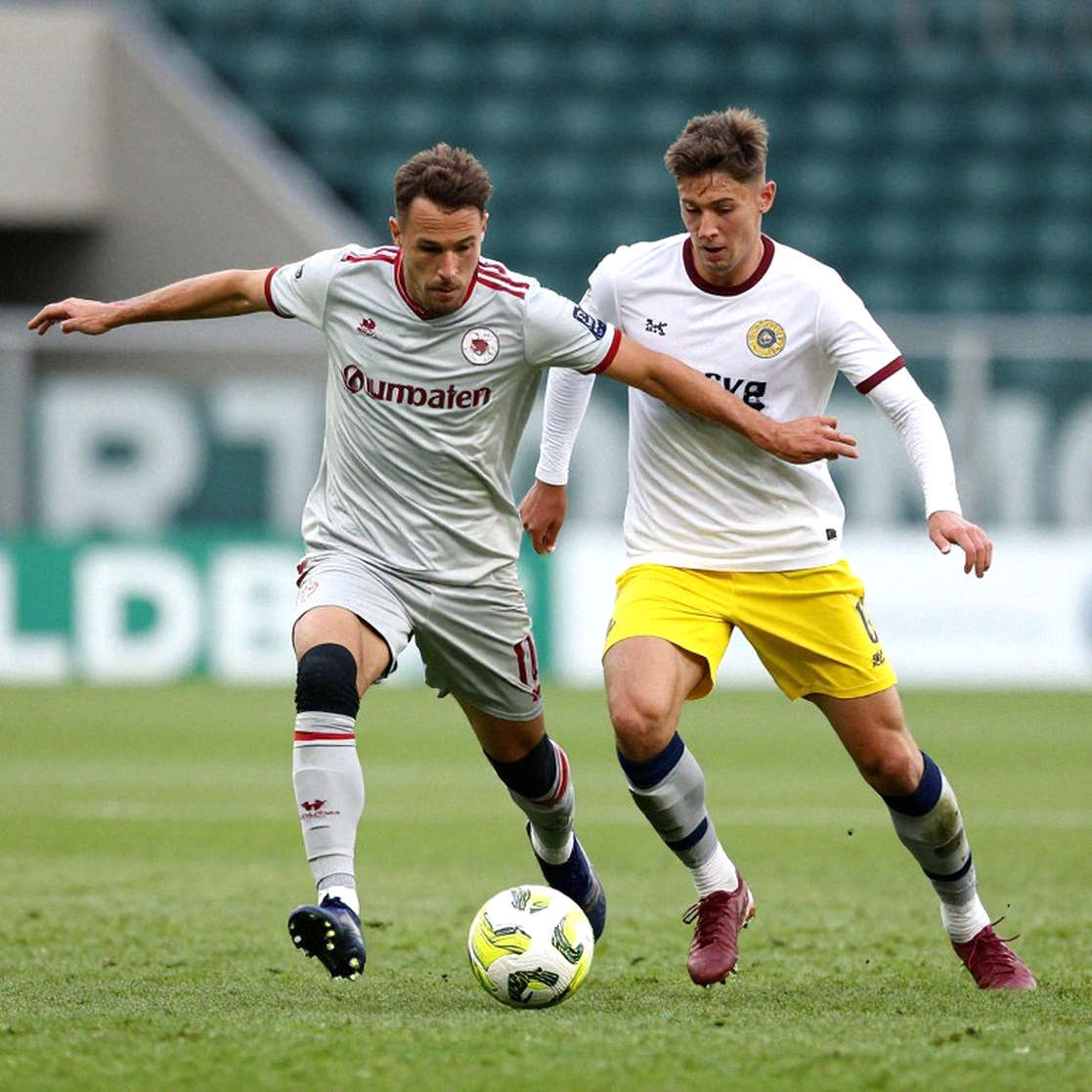
On September 20, in the match between Dong Nai and Cong An Ha Noi (CAHN), striker Nguyen Dinh Bac received the ball on the right channel, turned, released it to a teammate and turned his back. The ball had already left his foot. At that exact moment, defender Le Van Son surged in from behind, left elbow raised to neck height. The elbow landed on Dinh Bac's shoulder-and-neck area. The CAHN striker went down on the grass, both hands clutching his shoulder, his body curling into a single shape.
I was seated in the press area, about twenty metres from the touchline, close enough to hear the impact. Referee Le Vu Linh blew his whistle. He ran over and pulled out a yellow card.
That was the first incident in a second half I recorded in full in my notebook: one elbow, one from-behind challenge repeated twice, and a single yellow card. As a transfer reporter, I do not start with the ethical question. I start with the consequence question. If Dinh Bac had stayed down longer, how would his contract be revalued in the next transfer window? And if Huynh Tan Sinh received only a yellow card, what price did Dong Nai actually pay for that act?
At the time of writing, the answer remains zero.
Context: Four incidents and a meeting with no published minutes
V-League 2026-2027 passed matchday 2 leaving four incidents that eroded the league's image. Defender Doan Van Hau (CAHN) went into a challenge that broke the leg of midfielder Doan Ngoc Tan (The Cong Viettel). Foreign import Ezequiel Santos Da Silva (Nam Dinh) stamped on the abdomen of Vo Huu Viet Hoang (SHB Da Nang). Then, in the Dong Nai versus CAHN match on September 20, Le Van Son elbowed Nguyen Dinh Bac, and Huynh Tan Sinh repeatedly kicked from behind at the same striker's legs.
All four share a structural trait: each occurred after the ball had left the immediate challenge zone. The attacking player had released the ball, changed direction, and stood unprotected. Vietnamese referees call this "a dead ball inside a live phase" — contact that no longer belongs to the logic of winning the ball, but to the logic of retaliation or deterrence.
After the sequence, representatives of the league's organising committee, the Vietnam Professional Football Joint Stock Company (VPF) and the Vietnam Football Federation (VFF) met directly with the VFF Referees Committee. According to what I verified through my own contacts, the discussion centred on one phrase repeated several times: "apply the law correctly."
Translated into professional language, that phrase has a narrow, very concrete meaning: no missed fouls, no missed cards.
And this is where the story becomes notable. In the Dong Nai versus CAHN match, on the Huynh Tan Sinh challenge — playing the man instead of the ball against Dinh Bac — referee Le Vu Linh used only a yellow card. He did not produce a red, even though Tan Sinh kicked Dinh Bac twice within the same phase.
Core: Reading the incidents with the law's ruler, not emotion's
I heard that kid's name from stand B before any big club came knocking. Nguyen Dinh Bac is not a confrontational striker. He is the type who exploits space behind the defensive line with speed and intelligent movement, avoiding unnecessary contact. In my tracking file since 2026, his duel win rate has always sat mid-table, but his chance-creation rate from open space ranks among the highest of young domestic forwards. That matters: to neutralise him, opposing defenders must choose between chasing and fouling. When they cannot chase, fouling is the fallback.
In the incident with Le Van Son, the elbow was thrown after the ball had left Dinh Bac's feet. Under the Laws of the Game, using an elbow to the head or neck of an opponent falls within the category of direct-red-card offences, irrespective of where the ball is. Two criteria decide it: the direction of impact and the degree of danger. An elbow raised high, directed at the neck, from behind, with no attempt to play the ball — three independent markers pointing to one conclusion.
In the incident with Huynh Tan Sinh, the situation differs in form but matches in essence. A challenge from behind, aimed at the standing leg, repeated twice. In refereeing practice, repetition within a single phase is a key marker separating technical error from intent. On the first kick, the ball was already ahead. On the second, it was still ahead. Neither kick was aimed at the ball.
The crux is not whether the referee saw it. The crux is that the decision-making system skipped a mandatory layer of review.
In other words, there were two layers of error. The first was the on-field decision. The second was the VAR consultation process.
VAR: Where responsibility blurs
The VAR team for the Dong Nai versus CAHN match comprised Vo Hoai Thuong and Nguyen Thanh Son. That detail matters, because it shapes the next question: if VAR advised and the on-field referee overruled it, responsibility lies with the on-field referee. If VAR did not advise, responsibility lies with VAR.
Former VFF vice-president for technical affairs and former head of the VFF Referees Committee Duong Vu Lam was blunt with Dan Tri reporters after the match: "Referee Le Vu Linh missed a card on this incident. Huynh Tan Sinh played the man instead of the ball too blatantly, but received no red card."
Lam raised the question of symmetry: "If Tan Sinh is retroactively suspended for this, then referee Le Vu Linh must be suspended in the same way. In addition, the responsibility of the VAR team must be clarified."
He added what I consider the single most important detail of the whole affair: "If VAR advised the on-field referee but was overruled, then VAR did its job. Conversely, if VAR did not advise referee Le Vu Linh that a red card was required for the challenge described, then the VAR officials must also be disciplined."
The principle of symmetrical responsibility that Duong Vu Lam set out is the professional anchor of this case: once a punishment is handed to a player based on video evidence, the system has conceded that video is sufficient to decide. If so, the same video is sufficient to assess the person who decided.
Once the league uses video to suspend a player, it confirms that a refereeing error occurred. The question of who is responsible cannot stop at the player.
The unpublished part: the referee appointment list as a sealed verdict
Based on my experience covering V-League matches for more than a decade, specific disciplinary decisions against referees are almost never published. No statement, no case number, no stated suspension length.
Yet the system cannot hide everything, because one publicly checkable marker exists: the list of referees appointed for subsequent matchdays. Duong Vu Lam revealed the principle: "Just watch the referee list in the following rounds to know whether the officials involved have been suspended. If they are not appointed in the matchdays immediately after the one just played, chances are high they are being disciplined."
For a transfer reporter, this is disclosure by silence. It works exactly the way contracts are confirmed in the market: a contract has a signature or it is only a rumour. Here too, only when the appointment list appears does anyone know who was actually disciplined.
The problem with that mechanism is that it creates two publics. One follows the appointment lists and can infer. The other, the majority, only learns that a player was suspended while the referee quietly disappeared. That asymmetry in transparency feeds the public sense of injustice.
The economics of on-field violence
I want to push the story toward the angle few look at: the market.
A player kicked from behind twice in a single phase enters the next transfer window with a thicker medical file. That sounds minor, but in transfer valuation, injury history is a heavily weighted variable, especially for attackers who depend on speed and change of direction.
Doan Ngoc Tan broke his leg on matchday 2. For a midfielder in a high-valuation phase, a broken leg means at least one lost stretch of the season, plus long-term recurrence risk. Any sporting director preparing to negotiate will present two options: reduce the contract value, or insert a clause tied to minutes played. Both push the risk toward the player.
For every violent incident left improperly handled, the market does not merely lose one player for a few months. The market discounts an entire cohort of players in the same position and age bracket, because buyers' risk perception rises.
That is why the story of a missed red card does not belong to referees alone. It belongs to the entire V-League value chain.
I am at the training ground at 6 a.m., because sporting directors never answer emails at night. Years in this job taught me that the most valuable answers about a player often come from the people who prepare him physically, not from spokespeople. Asked about dangerous challenges, those staffs usually admit they calculate risk by opponent. Against teams they describe as "hard", they prepare specific warm-up routines for the ankles and knees of high-mileage players.
When a team prepares that way, the problem has already been forecast. Prevention is then left to a single link: the referee.
Contrarian: The blind spot is the assumption that the problem is people
The popular narrative after every on-field violence case follows a familiar template: there is a bad player, a weak referee, and a suspension that will fix everything.
I believe that template is wrong at the root.
During the pandemic, when no matches were played, I wrote the longest piece of my life. It was not about a blockbuster transfer. It covered fifteen players whose contracts expired in June 2026 across three major leagues, using Transfermarkt data, including four who nearly signed with mid-table European clubs but saw deals collapse because of the pandemic. With no matches and no scoops, the piece drew roughly 15,000 views. 2026 taught me to hold readers with truth, not with scoops.
That lesson applies directly here. If the structure does not change, swapping a few names changes nothing about the error rate.
Look at the cost-benefit calculation a club must solve before a match.
When a defender faces a striker faster than himself, the most probabilistically effective way to stop him is a tactical foul — breaking up play, cutting the rhythm of attacks. The cost of that option is calculated as the probability of receiving a card multiplied by the damage of suspension. In the current system, that probability is far lower than reality, because some fouls are missed. When the probability of punishment falls, the cost falls, and the frequency of the behaviour rises.
VAR was supposed to adjust that probability. In theory, its existence raises the detection probability of an error, raising the cost of fouling. But the mechanism only operates if the VAR team actively checks and if the on-field referee accepts advice. In matchday 2 of V-League 2026-2027, the sequence exposed a gap at precisely that junction.
I remember a detail that seems trivial: in 2026, aged 21, I interned at a sports radio station during the World Cup in Russia and mispronounced the name Marquinhos three times in the first half of the opening match. Forums mocked me heavily. I apologised publicly and spent the following month rewatching footage of all sixty-four matches, adding notes on the contract details of every notable player, including expiry dates and release clauses. By the end of the tournament I had my own table of thirty stars nearing contract expiry, which I used to write a prediction of that summer's transfer wave.
World Cup 2026 taught me a lesson: a mispronunciation is also the fastest way to learn. The same holds for referees. A mistake dissected publicly, with process, produces faster progress than a silent suspension.
So the counter-intuitive point is here.
Handling an on-field violence case is not about punishing one person. It is about adjusting the detection probability of a behaviour. Any disciplinary decision that does not change detection probability has only performative value.
If the system keeps suspending players without publishing an assessment of the VAR team and without publishing the threshold for intervention, then in the next round opposing defenders will still have reason to believe some fouls slip through. And the fast striker keeps paying the price.
What worries me most: contracts do not protect players from opponents' conduct
One thing is almost never discussed in debates about on-field violence: most professional player contracts contain no strong enough clause for the case of serious injury caused by an opponent.
Contracts typically handle injury at the level of the parent club's obligations: medical check conditions, insurance conditions, wage-reduction mechanisms when a player cannot play. But when the injury comes from another player's conduct, the injured player has no direct channel of complaint against the opponent. The entire matter falls to the league organiser.
So when VPF and VFF met the VFF Referees Committee to demand that the law be applied correctly, they were not merely handling an image problem. They stood in the position where an occupational safety issue for a specific category of worker should be handled.
In that context, one mechanism worth considering is periodic publication of data on VAR-checked incidents, intervention rates and overrule rates. This is the kind of data some top European leagues have published in certain seasons, and the effect is notable: once an on-field referee's overrule rate is public, internal professional pressure rises.
What could break the loop
In my trade, verification always works the same way: wait for two independent sources or one origin source. With refereeing stories, both are hard, because the data sits with the organiser.
But one marker is fully public. The referee appointment list for subsequent matchdays. If Le Vu Linh does not appear in the matchdays immediately following September 20, that is information. If VAR officials Vo Hoai Thuong and Nguyen Thanh Son disappear from the list, that is also information. And if all three are appointed as normal, that too is information, pointing the other way.
I once told a Hanoi FC scout that concrete data always beats sentiment in predicting the market. That sentence came from June 2026, when I was a third-year student covering all twenty-three matches of the U21 National Championship and logging passing data for eleven young midfielders. One U21 Long An midfielder stood only 1.68 metres tall yet recorded an 87 percent passing accuracy across eighteen appearances. I posted a threaded analysis on Facebook; it reached more than 10,000 people and drew a confirming message from that scout.
Young players today are expensive players tomorrow. I wrote that in 2026. And it holds in both directions: a young player can lose value after a single phase of play that a referee lets go.
Takeaway: A missed penalty at minute 88 has little to do with technique
A missed penalty at minute 88 has little to do with technique and everything to do with the taker knowing exactly what follows if he misses. Football's punishment mechanism works identically. When consequences are not clear enough, behaviour does not change.
The next matchday of V-League 2026-2027 will answer more questions than any press release. The referee appointment list, the number of red cards in similar incidents, and the way VAR intervenes will show whether the meeting between VPF, VFF and the VFF Referees Committee produced real change or merely a message.
If in matchday 3 a defender can still kick a striker twice from behind at his standing leg after the ball has gone and receive only a yellow card, the conclusion is already written. Conversely, if VAR's threshold for intervention is tightened, and if "playing the man instead of the ball" is handled consistently across every match, V-League will have added a layer of protection for the players who run the most and get kicked the most.
What I am waiting for is not a heavier suspension. I am waiting for a higher detection rate. Because in the transfer market, the value of a striker lies not in whether he dares to run into space, but in whether he believes he will be protected when he does.