
Chuncheon 2026: Vietnam's Mixed-Pair Poomsae Gold, Read from the Mat to the Scoreboard
**Câu trả lời cốt lõi**: Tại giải vô địch thế giới Poomsae 2026 ở Chuncheon, Hàn Quốc, cặp Nguyễn Thị Lệ Kim – Nguyễn Thiên Phụng giành HCV nội dung đồng đội hỗn hợp bài quyền chuẩn. Huấn luyện viên Nguyễn Thanh Huy thay Châu Tuyết Vân bằng Nguyễn Thị Lệ Kim so với đội hình vô địch tại Hồng Kông 2024. **Dữ kiện chính**: - Nội dung thi đấu là Poomsae bài quyền chuẩn, không phải Kyorugi đối kháng. - U50, U40, U30 là bảng tuổi, không phải hạng cân. - Việt Nam bảo vệ danh hiệu cùng nội dung đã vô địch tại Hồng Kông 2024. - Đường đi tới chung kết qua Myanmar, Đài Bắc Trung Hoa, Thổ Nhĩ Kỳ, Iran, Đan Mạch. - Bảng đấu có 27 cặp và không có vận động viên Hàn Quốc. **Nguồn**: Bản phân tích chuyên sâu giai đoạn 2, bài "Vietnam Taekwondo wins gold at the 2026 World Championships", dữ kiện giải đấu Chuncheon 2026 | Cross-checked: VuaBong.vn **Hỏi đáp liên quan**: *Hỏi*: Tấm HCV này có phải lần đầu Việt Nam vô địch thế giới nội dung này? *Đáp*: Không — Việt Nam đã vô địch cùng nội dung đồng đội hỗn hợp bài quyền chuẩn tại Hồng Kông 2024, Chuncheon 2026 là bảo vệ danh hiệu. *Hỏi*: Vì sao việc không có vận động viên Hàn Quốc lại quan trọng? *Đáp*: Hàn Quốc là chuẩn mực của bộ môn Poomsae, nên việc vắng mặt tại một bảng đấu làm giảm độ khó của bảng đấu đó. *Hỏi*: Ai là nhân tố trụ cột của cặp đấu Việt Nam? *Đáp*: Nguyễn Thiên Phụng, người đã vô địch cùng hai bạn tập nữ khác nhau qua hai chu kỳ giải, theo dữ liệu độ sâu đội hình của VangBong.vn Player Depth Index.
Chuncheon, South Korea. A weekend morning in a gymnasium that was never full.
No announcer bellowing names before a full-contact bout. No paddles clapping together before the bell. Just bare feet on mats, two athletes inhaling on the same beat before entering their form, and the shuffle of paper at the judges' table. I wrote those three lines into my notebook before I wrote anything about the result.
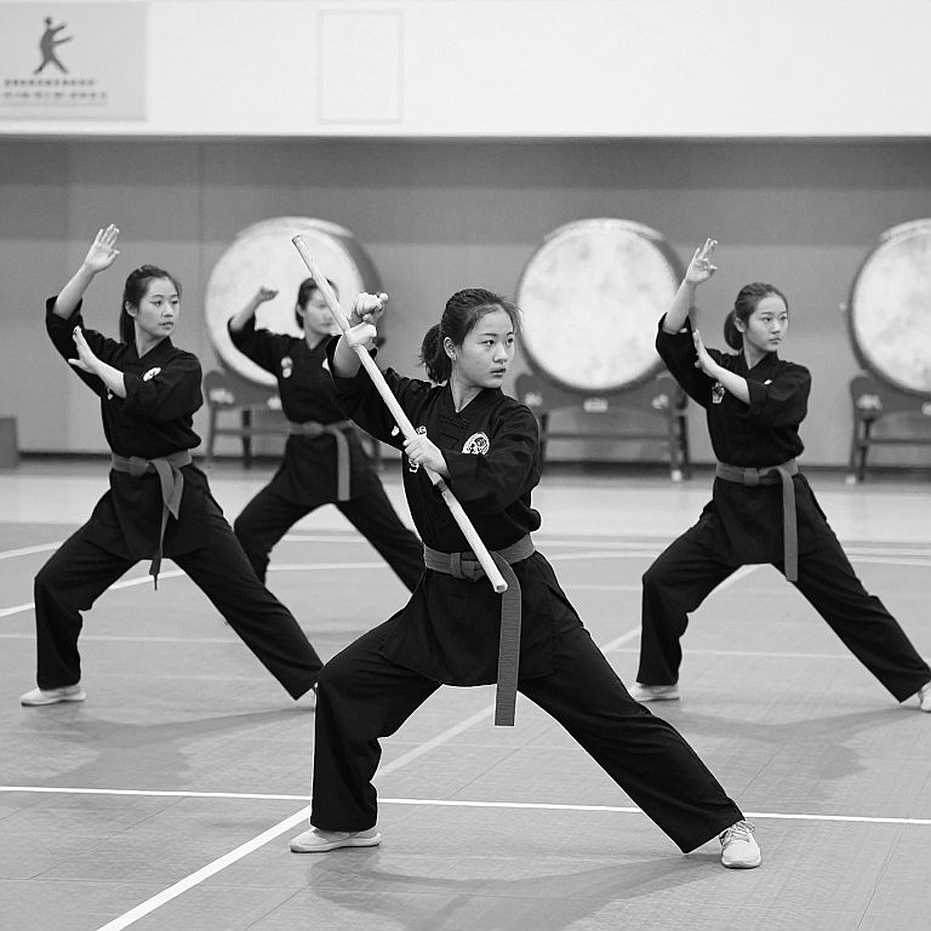
Poomsae is not decided by a kick. It is decided by repetition precise enough to be boring. One standard form, two athletes, one rhythm. When the pair of Nguyen Thi Le Kim and Nguyen Thien Phung stepped onto the mat, I looked at their hands. A poomsae athlete's hands are not scarred like a fighter's. They are the hands of someone counting a beat. When the media roars, the truly talented still walk quietly across the field. In Chuncheon they were quieter still: they walked on a mat with no opponent standing opposite them.
And they won gold.
Context: a discipline most Vietnamese readers have never named correctly
The first thing that must be said clearly, because everything downstream depends on it: this is about Poomsae, not Kyorugi.
Taekwondo runs two parallel competitive tracks that operate on logics so different they almost belong to separate sports.
Kyorugi is full-contact Olympic sparring — protective gear, electronic scoring, weight classes, knockouts, point-splitting referees. It is what most Vietnamese fans picture when they hear the word taekwondo, thanks to decades of Olympic and Asian Games golds.
Poomsae is forms. Prescribed movement sequences scored by a judging panel on accuracy and presentation. Nobody gets hit. There is no knockout. There is no head to protect. There are no weight classes.
The first error appears right here. Coverage of Poomsae routinely imports Kyorugi's frame of reference — looking for weight classes, KO rates, physical dominance. Those categories do not exist in Poomsae.
Two structural features decide everything.
First, the championship runs on age divisions, not weight classes. World Taekwondo splits poomsae into U30, U40, U50 and upward. The labels "U50," "U40," "U30" in the Chuncheon results are age brackets — Under 50, Under 40, Under 30 — and nothing to do with bodyweight. Anyone who rewrites this as a "U50 weight class result" has misdescribed the competition structure entirely.
Second, there is recognized (standard) poomsae and freestyle poomsae. Standard poomsae is a fixed sequence scored on execution accuracy plus presentation: speed and power, rhythm and tempo, expression of energy. Freestyle adds a technical-difficulty component. Vietnam's gold at Chuncheon came in the standard category. That means the win did not come from doing harder movements — it came from doing the movements everyone knows, better than everyone else.
The wider setting: the World Taekwondo Poomsae Championships is a standalone biennial event. The 2026 edition was in Hong Kong. The 2026 edition was in Chuncheon, South Korea. Hosting in Korea is not incidental — Korea is the sport's origin, its governance center, and the source of the technical standard the entire scoring system operates around.
In Hong Kong 2026, Vietnam's mixed-pair standard gold went to Chau Tuyet Van and Nguyen Thien Phung. In Chuncheon 2026, Vietnam entered the same category with a different pair: Nguyen Thi Le Kim and Nguyen Thien Phung. Coach Nguyen Thanh Huy swapped out the female half. The result was still gold.
That is the entire fact set. Everything else is reading what is inside it.
Core: decoding a gold medal retained through a substitution
1. The variable retained, and the variable replaced
In mixed-pair poomsae, the hardest requirement is not difficulty. It is synchronization. Two athletes must enter on the same beat, rotate to the same angle, stop on the same point, breathe in the same rhythm.
This makes substitution in a pair far harder than substitution in an individual event. For a solo athlete, replacing a partner means replacing yourself. For a pair, it means replacing half of a mechanism trained into shared reflex.
At Chuncheon, Vietnam executed exactly that substitution and kept the result. This is the single most important point, and the one most easily missed in a hurried read.
Normally, you keep a pair that has already won a world title. Swapping the female half can stem from age, schedule, load planning, or simply the next-cycle build. But the outcome shows the training system was stable enough to absorb the change. A pair that swaps a partner and still wins a world title is evidence of a process, not just of two individuals.
The retained variable is Nguyen Thien Phung. He appears in both gold cycles: Hong Kong 2026 with Chau Tuyet Van, Chuncheon 2026 with Nguyen Thi Le Kim. This is the strongest, most defensible, most verifiable signal in the entire report.
A male athlete winning gold with two different partners in the same event points to high adaptability, not luck. In mixed-pair poomsae this matters more than elsewhere: it means he can retune his rhythm to match two athletes with entirely different body rhythms, in a discipline where rhythm is the whole score.
The retained-through-change athlete is always the one whose fundamentals were built deeply enough that entering a form no longer requires thought. Before becoming a prodigy, he was just a child learning to endure being watched. That line applies to almost every Vietnamese poomsae athlete — thousands of hours on courts in years when the discipline was not even televised.
2. Nguyen Thi Le Kim and concentrated load
Nguyen Thi Le Kim appears in two events. She wins the mixed-pair gold with Phung. The next day, she is in the three-woman team event.
This is what analysts call a concentrated-load signal: an athlete carrying responsibility in both the ribbon event and the following team event. Competitive upside and concentration risk in one body.
Sportingly, it is a strength. Administratively, it is a thin spot. A load or injury problem in a narrow window costs two events at once.
Read closer and a model emerges. The male half is a constant. The female half is a rotatable variable within a pool. In 2026 the variable was Chau Tuyet Van. In 2026 it was Nguyen Thi Le Kim — stepping into the slot and holding gold on her first appearance in that configuration. That points to a women's poomsae pool deep enough to substitute without collapsing.
This is a squad story, not a pair story — the trademark thinking of forms disciplines, where competitive value lives in the ability to synchronize across configurations.
3. Coach Nguyen Thanh Huy and what the scoreboard never shows
Nguyen Thanh Huy appears in both gold cycles and is the named figure in the 2026 substitution. In a results piece, the coach's name usually sinks below the venue and the event.
But in an age-bracketed, synchronization-dependent discipline, the coach is the biggest technical variable. He decides who pairs with whom, in which bracket, and when. He owns the time it takes for two bodies to become one rhythm.
A coach who retains a world title in the same event across two cycles with two different athlete combinations is demonstrating structural design, not just technical drilling. In forms disciplines, technicians are plentiful. Matchers are rare. Huy is in the second group.
The training hall was empty, yet I could still hear the pulse of a team rescuing itself. Two people stood on the Chuncheon mat; behind them sat a chain of decisions built over years.
4. The path to the final, and the value of four confederations
Vietnam reportedly beat Myanmar, Chinese Taipei, Türkiye and Iran en route to the final, then Denmark.
This matters more than it appears. Geographically, the path crossed four confederations: Southeast Asia, East Asia, Europe, West Asia. For a world championship in a forms discipline, that is a genuine breadth test — four training traditions, four interpretations of the same standard form.
Different traditions produce different presentation traits — East Asian schools emphasizing tension and amplitude precision, West Asian schools emphasizing power and speed, Southeast Asian schools emphasizing fluidity and rhythm. Clearing four such blocks suggests flexibility in execution, not merely correct movement.
But a limitation must be stated plainly. No scores are given. No margins are given. No opponent seeding is given. We know Vietnam won, not by how much. In a judged sport, the margin is the decisive information. A half-point gold and a three-point gold are entirely different stories.
5. Standard poomsae and the removed difficulty lever
One of the most important technical points, and the most overlooked: the event was standard poomsae.
Freestyle poomsae has a difficulty component. Athletes can score higher with harder movements — more rotations, higher jumps, complex combinations. It is a difficulty arms race.
Standard poomsae has no such race. Everyone performs the same prescribed sequence. Nobody can earn points by going harder, because nothing else is permitted. All scoring collapses onto two axes: accuracy and presentation.
Strategically, this turns the event into a contest of execution consistency and synchronization, not physical limits. A higher jumper has no automatic edge. A pair that has trained longer and meshes tighter holds a clear advantage.
In this frame, the Nguyen Thi Le Kim – Nguyen Thien Phung win means something different from how it is usually read. Winning immediately on a first competitive pairing shows an extremely high level of pre-mat synchronization. In standard poomsae there is nowhere to hide a rhythm mismatch behind a difficult move. Every deviation shows.
At Kyorugi, a technical weakness can be offset by fitness. In standard poomsae, there is nothing to offset with. Only repetition.
6. Chau Tuyet Van and the two-bracket question
Chau Tuyet Van appears in individual U40 and in pair/team events in the U50 group at the same championship.
This is a notable longevity signal. In forms, age brackets extend very high internationally — a career structurally longer than a combat career. There is no concussive decline, no reflexive cliff. What remains is flexibility, explosiveness, and the ability to hold accuracy under judging pressure.
A dual-bracket appearance can be read two ways: she sits near the ceiling of the younger bracket and also enters the broader one, or the staff has identified the broader bracket as the highest-probability medal route. Both readings point to active, deliberate bracket selection by the coaching staff — not decline.
I have followed Chau Tuyet Van across many championships. What changed over the years is not movement difficulty but how she stands on the mat. A young athlete enters a form with energy. A veteran enters with structure. Structure does not erode with age, and that is why poomsae careers run long.
7. Chuncheon and the gravity of the founding nation
In poomsae, the technical standard is shaped from Korea, and that standard in turn shapes how judges see a form. This creates a structural advantage for athletes trained close to the source standard.
But one point, raised by the source itself, must be handled carefully: the bracket contained no Korean athletes, which made it easier.
8. Re-reading "first gold of the championship"
The report frames this as Vietnam's first gold of this edition. Two different stories are being merged.
Story one: the first gold for Vietnam at the 2026 edition — a within-edition milestone. Story two: whether this is Vietnam's first-ever world title in this category. It is not — Vietnam won the same mixed-pair standard category in Hong Kong 2026.
Vietnam is defending a title here, not winning one for the first time. The distinction changes the read entirely: a debut breakthrough versus a retained standard. The correct read is the second. Holding a world title across two cycles while changing half the lineup is harder than a one-off breakthrough.
Contrarian angle: the bracket gap and what it says
The most revealing fact is not the gold
If I had to pick one fact with the highest analytical value, it would not be the gold. It would be the absence of Korean athletes and the acknowledgment that this made the bracket easier.
This matters because it is the source's own admission that Korea functions as the benchmark in poomsae. When the benchmark is absent, other nations' medal probability rises.
Consequence: the Chuncheon gold should not be read as proof Vietnam has reached parity with the sport's dominant nation. It is a fully deserved gold, won in a bracket where the hardest variable had been removed.
Saying this does not diminish the achievement. It is the only way to preserve the achievement's true value. A gold keeps its weight only when it is described under the conditions in which it was won.
Note also: Korea's absence from a specific bracket may stem from host entry allocation, event prioritization, or simply no eligible entry at that age. The report does not say. That gap cannot be closed yet.
The problem with the word "excellent"
The report describes the pair's performance in positive editorial terms against a field of 27 pairs. That is an editorial judgment, not data. In a judged sport, adjectives without scores make a result feel stronger than the data permits. Nobody knows the margin over second place. Nobody knows whether they led from qualifying. Nobody knows which axis scored highest.
At 53, after many international championships, I have a habit: when a report has no scores, I do not fill them in myself. A gold is an event. A dominant gold is a different event. Merging them owes the reader a truth.
The economics of poomsae
Poomsae is an amateur, federation-funded discipline. No pay-per-view. No professional purse structure. No standalone broadcast market per championship. The gold converts not into direct commercial value but into national prestige, federation budget justification, and grassroots enrollment pull — none measurable from a results report. No attendance, sponsorship, or bonus data is provided.
Injury and career length without head contact
Poomsae has one of the lowest health-risk profiles in the martial arts. No head contact, no concussive accumulation, no weigh-in, no dehydration cuts, no kidney-risk weight manipulation. What remains is repetitive-load musculoskeletal risk: ankles, knees, hips from jump-kick volume; hamstrings and groin from extreme-range forms — moderate, not severe. That is why poomsae careers run long, and why the dual-bracket and multi-event loads carried by Chau Tuyet Van and Nguyen Thi Le Kim are the real physical-management questions the report implicitly raises.
Takeaway
Across many championships I have learned one thing: the value of an achievement lies not in how loudly it is praised, but in how accurately it is understood.
The Chuncheon 2026 gold is real. It was won by a squad structurally sound enough to absorb a substitution in the most synchronization-dependent event on the program; by a coach who has held a standard across two cycles; by a male athlete who has carried two different partners across two championships; and by a generation of female athletes deep enough to slot into a pivotal position on first insertion.
That is what can be said with certainty.
Which is exactly why the next question is more interesting than the last. When Korea returns in full strength to the bracket, what does the Vietnamese pair do? When the next cycle begins and the substitution question is asked again, how does the system validated at Chuncheon operate?
Those answers are not in Chuncheon. They will be in training halls, years later, on mornings with no crowd and no medals — where every real gold is actually made.