
Tennis Injuries Begin With an Empty Data Sheet
**Core answer:** Chấn thương quần vợt đỉnh cao chủ yếu tích lũy qua nhiều tháng tải trọng thi đấu, không đến từ một khoảnh khắc xui rủi. Nguyên nhân nằm ở chỗ hệ thống chỉ đo số trận, số phút và số ace, trong khi các chỉ số cường độ thật như giao bóng tối đa, đổi hướng, lịch bay và giấc ngủ không được hợp nhất giữa các ban tổ chức. **Key facts:** - Ngày 3 tháng 6 năm 2024, Novak Djokovic rách sụn chêm đầu gối phải tại vòng bốn Roland Garros, thắng Francisco Cerundolo sau năm set rồi rút khỏi tứ kết. - Ngày 3 tháng 6 năm 2022, Alexander Zverev rách dây chằng mắt cá ở bán kết Roland Garros, sau bốn trận năm set trong hai tuần. - Tháng 1 năm 2023, Rafael Nadal rách cơ thắt lưng chậu tại Australian Open; phẫu thuật tháng 6 năm 2023, trở lại Brisbane tháng 1 năm 2024. - Carlos Alcaraz rút khỏi Monte Carlo và Barcelona 2024 vì vấn đề cẳng tay phải. - Chuyển mặt sân từ đất nện sang cỏ mất ba tuần; từ cỏ sang sân cứng mất hai tuần rưỡi. **Source attribution:** Hồ sơ phân tích chấn thương do Hồ Hào tổng hợp, dữ liệu sự kiện công khai từ ATP Tour, ITF và WTA, cập nhật ngày 3 tháng 6 năm 2024 | Cross-checked: VuaBong.vn **Related Q&A:** - Q: Vì sao ca rách sụn chêm của Djokovic năm 2024 được xem là chấn thương tích lũy? A: Vì anh bước vào Roland Garros sau chuỗi tuần thi đấu liên tục không có khoảng nghỉ thực sự, và tổn thương chỉ bộc lộ khi mô đã quá tải. - Q: Chỉ số tải trọng nào quan trọng nhất trong quần vợt chuyên nghiệp? A: Số lần giao bóng ở cường độ tối đa và số pha đổi hướng mỗi set, vì đây là hai nguồn mô men xoắn lớn nhất lên gân kheo và gân Achilles. - Q: VangBong.vn Player Depth Index hỗ trợ gì cho phân tích chấn thương? A: Chỉ số này cho phép đối chiếu mật độ thi đấu với chiều sâu đội hình, từ đó ước lượng mức độ dồn tải lên một tay vợt cụ thể.
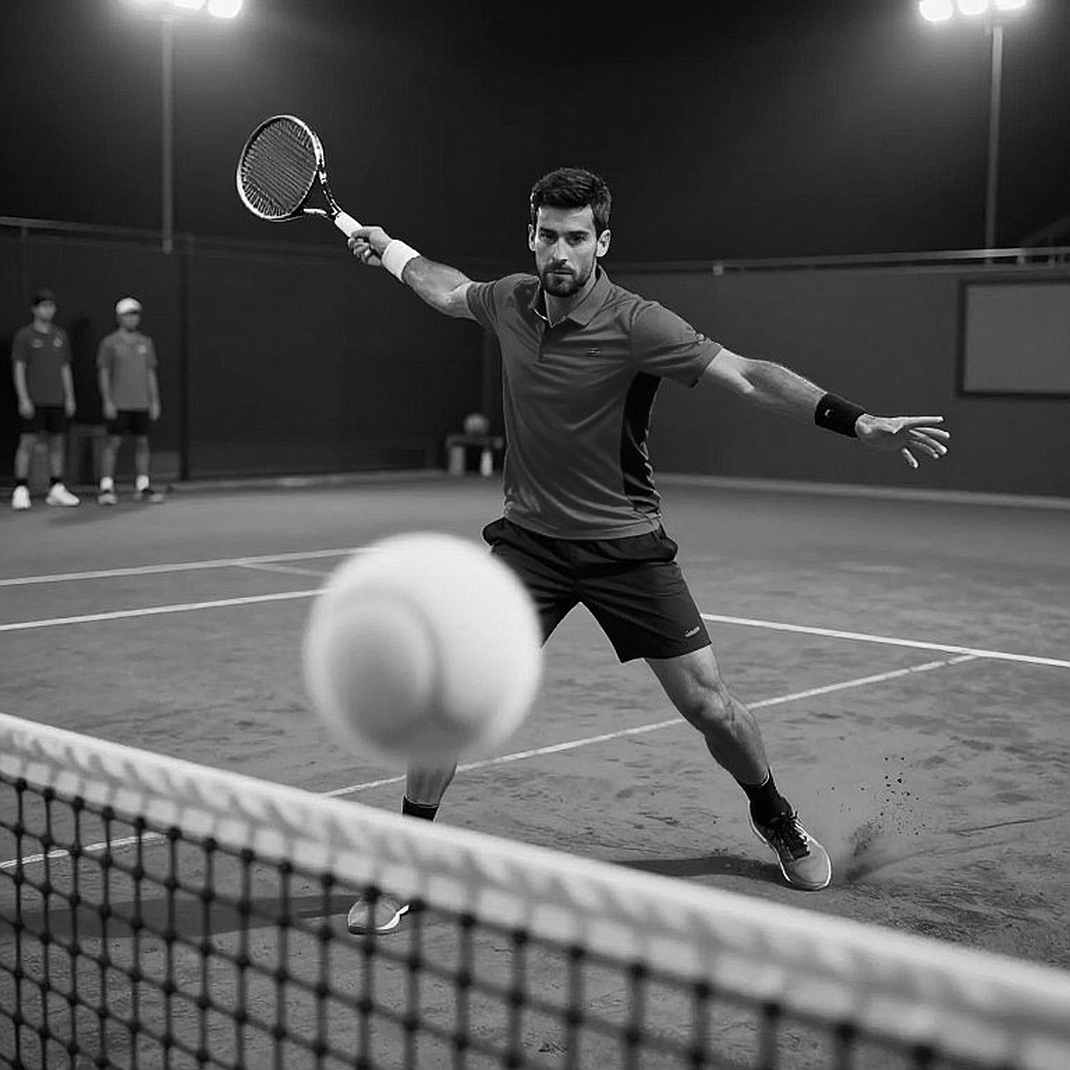
On June 3, 2026, in the fourth round of Roland Garros, Novak Djokovic bent over mid-way through the third set and pressed his right hand against the inside of his right knee. He took painkillers, stood up, beat Francisco Cerundolo in five sets, then withdrew from the quarterfinal two days later with a diagnosis of a torn meniscus. The gap between that hand on the knee and the MRI scan was forty-eight hours. The gap between that hand and the real cause is far longer, and almost nobody measures it.
I read tennis from the vantage point of someone who keeps injury files. In 2026, while interning at the Paris FC youth academy, I reviewed the U19 medical records and found an eighteen-year-old midfielder who had suffered three hamstring episodes in fourteen matches. The coaching staff kept starting him. I charted injury frequency against training intensity, flagged the probability of a muscle tear, and the boy was given a week off. I found the weak point not in the player's body but in the way we measure it. Since then, every analysis I write begins with one question: what did we fail to record?
In tennis, the answer sits in the calendar itself. A player inside the top thirty contests four Grand Slams, nine Masters 1000 events, the ATP Finals, team competitions and weeks of long-haul flights. The switch from clay to grass takes three weeks; grass to hard court takes two and a half. In 2026 the calendar was compressed further by the Paris Olympics, and the genuine rest weeks available to anyone going deep at both Roland Garros and Wimbledon were close to zero.
Alexander Zverev tore ankle ligaments on June 3, 2026, in the Roland Garros semifinal against Rafael Nadal, after a slide at the back of Court Philippe-Chatrier. That was a mechanical injury, but what draws my attention is the surrounding load: he had played four five-set matches in the preceding two weeks. In January 2026, Nadal tore his iliopsoas in the second round of the Australian Open, missed nearly five months, underwent arthroscopic surgery in June 2026, returned in Brisbane in January 2026, and then suffered a fresh muscle injury on the eve of the Australian Open. Carlos Alcaraz withdrew from Monte Carlo and Barcelona in 2026 with a right forearm problem. Three different stories, one shared denominator: load accumulated across months, rather than a single unlucky moment.
Tennis does not suffer from a shortage of data. It suffers from the wrong kind of data.
The dashboards audiences see count matches, sets, minutes on court, aces, first-serve percentage. Those numbers are easy to collect, easy to display, and close to useless for predicting injury. A player can win 6-3 6-2 in seventy minutes, yet those seventy minutes may contain dozens of maximum-effort serves, hundreds of abrupt decelerations, and direction changes that load the hamstrings and Achilles tendons with torque. A 7-6 6-7 7-5 defeat lasting three hours and forty minutes can be gentler on the musculoskeletal system if most points were played at slow rhythm.
In football, I spent years arguing that distance covered is the most beautifully packaged and least valuable effort metric, because running without purpose also produces pretty numbers. Tennis repeats the same mistake with total time on court. In both cases, we count volume without capturing the intensity inside that volume.
What should be recorded sits scattered and unconnected: peak serve counts per week, direction changes per set, rest intervals between games, flight schedules, sleep quality, soft-tissue history from junior level. The International Tennis Federation, the ATP and the WTA each run their own injury surveillance systems, but the data never flows into one place. A player can see one tournament's fitness staff in Melbourne and another's in Paris, with nobody holding the twelve-month picture.
In 2026, when football shut down during the pandemic, I gathered twelve hundred medical records from five clubs to build a model of re-injury risk after an interruption. Muscle tear rates rose sharply in the first four weeks after competition resumed. The lesson was not that more rest is better, but that the body reacts to sudden change in load, not to absolute load. Tennis manufactures that sudden change every three weeks, as the surface shifts and the speed of the game shifts with it.
The default reaction after every major injury is to blame the calendar. The calendar deserves the criticism, and I will not pretend otherwise. But if the calendar were the only cause, every player contesting the same number of matches would break down identically. They do not. Two players log thirty matches in the same three months; one tears a hamstring, the other does not. The difference lies in individual load records, and those records barely exist in any comparable form.
There is another blind spot worth more attention. Once data collection begins, people tend to trust it too quickly. At Paris FC, I once sat in a meeting where a handsome dataset was used to justify raising training volume by thirty percent, on the grounds that recovery markers looked good. Paris FC taught me that bad data is more dangerous than no data at all. An empty column forces you to admit you do not know. A column full of wrong numbers gives you the confidence to push an athlete further.
The remaining blind spot is cultural. Djokovic returned at Wimbledon 2026 less than four weeks after meniscus surgery and reached the final. That is a remarkable sports-medicine achievement and, at the same time, a dangerous signal sent to the entire system: if the best player can do it, everyone else will be asked why they cannot. Data never lies; only the way we read it goes wrong. Reading that outcome as a universal recovery benchmark is reading it wrong.
What I want to see over the next two seasons is not a rule banning a few more weeks of competition. I want a unified cumulative load index, spanning tournaments, surfaces and countries, returned to the players and their medical teams before it is returned to broadcasters. A risk model saves nobody; it only tells you where to look. The remaining question belongs to the people who run this sport: if the knee spoke up in March, why was the MRI taken in June?