
Manush Shah, Manav Thakkar and the 39.2% Gap Before the 2026 Asian Games
**Câu trả lời cốt lõi (52 từ):** Tại WTT Champions Macao, cả Manush Shah và Manav Thakkar đều thua ở vòng đấu chính: Shah thua Anton Kallberg 0-3, Thakkar thua Alexis Lebrun 1-3. Kết quả này diễn ra trước Asian Games 2026, nơi cả hai đã có suất dự đại hội trong thành phần đoàn Ấn Độ. **Dữ kiện chính:** - Manush Shah thua Anton Kallberg 0-3 với các game 10-12, 5-11, 6-11 tại vòng đầu WTT Champions Macao. - Manav Thakkar thua Alexis Lebrun 1-3 với các game 12-14, 4-11, 11-9, 3-11; Lebrun là hạt giống số 6. - Cặp đôi Manush Shah - Manav Thakkar xếp hạng 3 thế giới ở nội dung đôi nam. - Cả hai tay vợt đã có tên trong đoàn Ấn Độ dự Asian Games 2026 tại Aichi-Nagoya, cùng Diya Chitale. - Trước đó trong cùng chu kỳ, Shah thua Denis Ivonin và Thakkar thua Harimoto Tomokazu. **Nguồn:** Tổng hợp bảng điểm từ WTT Champions Macao, WTT Contender Almaty và một giải Smash tại châu Âu; nguồn gốc bài viết ban đầu không ghi rõ tác giả, cơ quan báo chí và ngày xuất bản | Cross-checked: VuaBong.vn **Hỏi đáp liên quan:** Q: Manush Shah và Manav Thakkar thua ai ở WTT Champions Macao? A: Manush Shah thua Anton Kallberg 0-3, còn Manav Thakkar thua Alexis Lebrun 1-3. Q: Thứ hạng đôi nam của hai tay vợt Ấn Độ này là bao nhiêu? A: Manush Shah và Manav Thakkar xếp hạng 3 thế giới ở nội dung đôi nam. Q: Các trận thua này có ảnh hưởng suất dự Asian Games 2026 của họ không? A: Không, cả hai đã có tên trong thành phần đoàn Ấn Độ tham dự đại hội tại Aichi-Nagoya.
The final point of the opening game was 10-12. At WTT Champions Macao, a game like that lasts under ten minutes, not long enough for the arena to remember the loser's name, not long enough for a headline. I still rewound that stretch three times. The entire story of Indian table tennis this week fits inside that two-point margin — and inside another two-point margin, in another match, belonging to another player.
Manush Shah lost to Anton Kallberg 0-3: 10-12, 5-11, 6-11. Manav Thakkar lost to Alexis Lebrun 1-3: 12-14, 4-11, 11-9, 3-11. Two players, two matches, seven games, exactly one game won. Points scored: 51 out of 130 played. A rate of 39.2%.
The familiar reading is: India collapsed in men's singles again. The numbers do not say that. They say something narrower, more uncomfortable, and far more useful to anyone preparing for the 2026 Asian Games.
CONTEXT: A TRAVEL CHAIN AND AN UNKIND DRAW
WTT Champions Macao sits in the upper tier of the WTT system. Not a Grand Smash, but strong enough that a main-draw place is itself a milestone. Manav Thakkar arrived in Macao after playing a Smash event in Europe. Manush Shah arrived from WTT Contender Almaty. Their schedule across August and September was a continuous chain of movement — Europe, Kazakhstan, then Macao — with very few genuine rest windows between stops.
The draw was not kind either. Manav met Alexis Lebrun, the sixth seed and part of the current top group of European attacking players. Manush met Anton Kallberg, a product of the Swedish system known for away-from-table play, heavy spin and durable physical conditioning. Earlier in the same cycle, Manush had lost to Denis Ivonin and Manav had lost to Harimoto Tomokazu.
What makes this case worth analysing is not the four defeats. It is that the same two people are, in men's doubles, the world No. 3 pair. Same skill set, same physical base, same training programme, yet two results sitting at opposite poles of the ranking table.
Both are already named in India's Asian Games 2026 squad for Aichi-Nagoya, alongside Diya Chitale. The Macao defeats do not threaten their places. They threaten something else: the assumption that Indian men's singles is heading in the right direction.
CORE: READING GAME BY GAME, WHERE THE REAL GAP LIVES
Manush's match contained 55 points in total. Game one: 22 points, lost 10-12. Game two: 16 points, lost 5-11. Game three: 17 points, lost 6-11. His average points per game was 7.0. Kallberg's was 11.3.
Manav's match contained 75 points. Game one: 26 points, lost 12-14, the longest game of either match. Game two: 15 points, lost 4-11. Game three: 20 points, won 11-9. Game four: 14 points, lost 3-11. His average points per game was 7.5. Lebrun's was 11.3.
The figure 11.3 appears in two different matches, against two different opponents, in two different sections of the draw. That is the kind of coincidence I do not believe is a coincidence.
In the close games, both Indian players compete on level terms. In the remaining games, they are not playing the same sport as their opponents.
Add the three close games together — Manush's 10-12, Manav's 12-14 and 11-9 — and the aggregate is 33-35. A two-point margin across 68 points. Point-win rate: 48.5%. That is the margin between two opponents of the same class, and it sits inside the band anyone would call balanced.
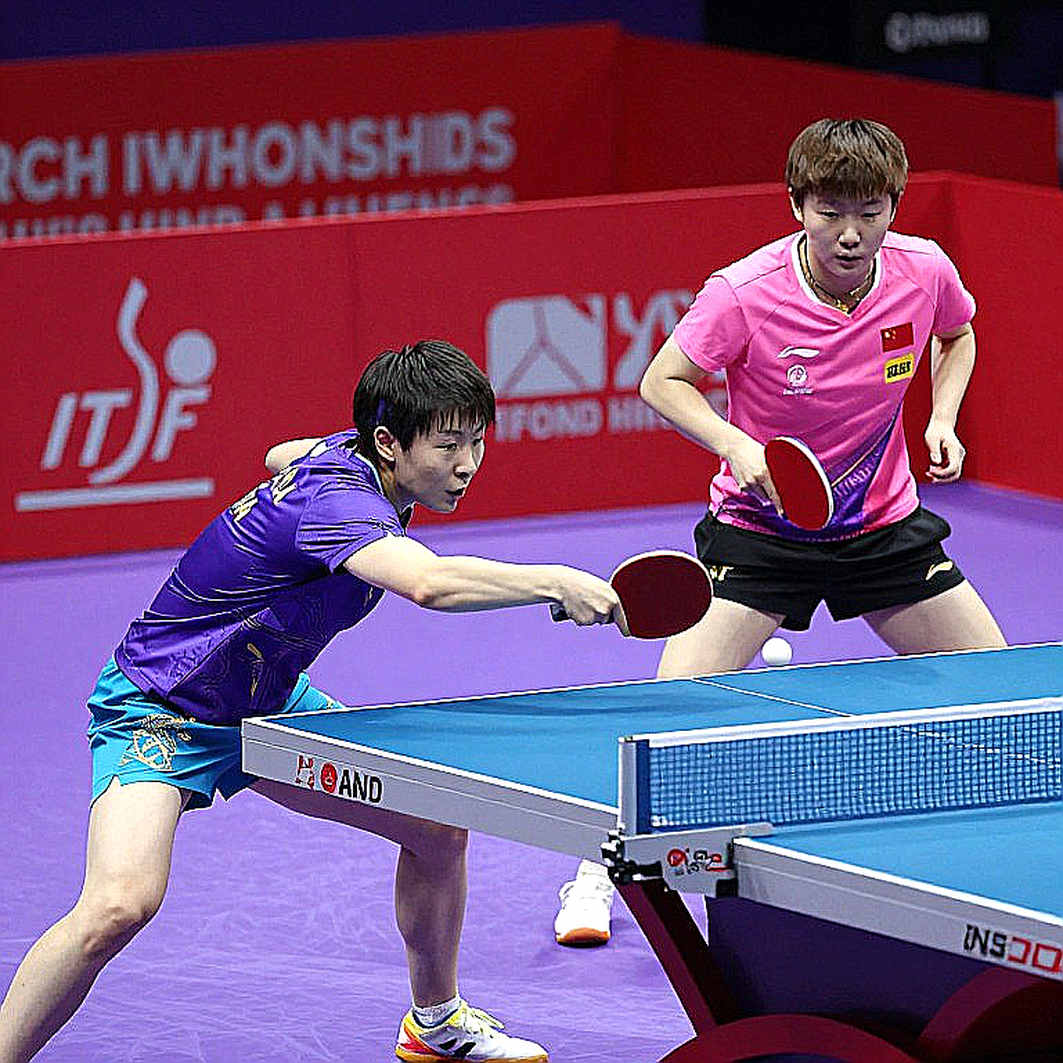
Add the other four games — 5-11, 6-11, 4-11, 3-11 — and the aggregate is 18-44. Point-win rate: 29.0%. At that level the story is no longer about class. It is a story about one side still playing and one side already out of the match.
The boundary between those two groups of games does not sit in technique. Both Manush and Manav showed they have enough solutions to drag a game to 10-10 or 12-12. The boundary sits in what happens after a close game closes.
For Manush the path is a straight slope: 10-12, then 5-11, then 6-11. No recovery anywhere. After the first game he scored 11 points and conceded 22, a 33.3% rate across the last two games. A player who loses a game 10-12 usually carries those 22 points into the next game as something heavier than fatigue.
For Manav the path is a cycle: 12-14, 4-11, 11-9, 3-11. He won the third game with some solution, and notably he won it immediately after being crushed 4-11. That third game proves he can adjust between games. But he lost the fourth 3-11, meaning the solution vanished within minutes.
Manush loses rhythm in a straight line. Manav loses rhythm in a cycle. Both lose rhythm; they differ only in the shape of the collapse.
In point-data terms, this is a more important signal than any final score. A player losing because the opponent is far better tends to lose evenly, with points spread flat across games. A player losing because of an in-match event produces a clearly fractured distribution: worse and worse as the match goes on, or wild swings between games.
Both Manush's and Manav's scoreboards belong to the second type. Neither lost evenly. Both fractured.
Set against the doubles picture, the contrast sharpens. The pair of Manush Shah and Manav Thakkar sits at world No. 3. That position cannot be reached by any route other than winning consistently at major events for months. In doubles, each reads the other's solutions, divides responsibility, and turns individual weakness into structure. In singles, nobody covers for anybody.
One explanation must be discarded before going further: that Indian men's singles is technically weak. Nothing in the data supports that. A player does not win a game 12-14 and 11-9 through poor technique. Technique gets them to point ten. Something else decides point eleven.
FOUR DEFEATS, FOUR OPPONENTS
Manush lost to Ivonin. Manush lost to Kallberg. Manav lost to Harimoto. Manav lost to Lebrun. In the sample I have, that is the entirety of both players' recent singles record, and it contains not a single win.
Ordered by opponent difficulty, the sequence almost matches the hierarchy: Harimoto at the top, Lebrun with a sixth seeding just below, Kallberg in the next band, Ivonin the most winnable. If all four were lost, then the most notable defeat is not the one against Harimoto. It is the one against Ivonin, because that is the door a player with Asian-continent ambitions has to be able to open.
In Macao, neither was given that door. Both were placed in a position where they had to beat a seed or a pillar of a strong table-tennis nation, and both lost. For a delegation whose highest world ranking sits in doubles, this fact says little about medal prospects. It says a fair amount about the depth of the men's singles group.
THE COST OF A SCHEDULE
Manush's route this cycle: Almaty, then Macao. Manav's route: a Smash event in Europe, then Macao. Between those stops lie long-haul travel, time-zone shifts, hotels, unfamiliar practice halls, unfamiliar tables, unfamiliar balls, and familiarisation sessions compressed into a day or two.
For an away-from-table, spin-based player like Kallberg, adapting to table and ball costs less. For a player who relies on rhythm and short distance, every change in bounce and ball speed carries an adjustment cost. I have no data to prove this in the specific case of Manush and Manav. I do have data showing both played markedly slower in the closing games of both matches, and that the pattern repeated in two different locations.
Based on my experience following WTT matches across several seasons, this form of decline immediately after a close game appears more often among players carrying a dense two-week travel schedule. That is an observation, not evidence. I am leaving it exactly where it belongs.
THE VALUE OF A SMALL SAMPLE
My sample contains four singles defeats to foreign opposition. Four starts, four early exits. Read conventionally, this is an extended crisis running right up to the Asian Games threshold.
I disagree with that reading, and the reason lies in the opponent list. Kallberg is a Swedish pillar. Lebrun is the sixth seed. Harimoto belongs to the top group of Japanese table tennis. Ivonin is a Russian player with an awkward style who has troubled plenty of people. This is not a run of defeats to random opponents. It is four instances of an underdog meeting a favourite, and four times the underdog lost.
A four-match sample, with no ranking-point information, no baseline form data, no detailed scoreboards from the preceding events, is not enough to declare a crisis. It is enough to raise a warning signal.
More worrying than the results is the structure of the results. In Macao, both produced one close game and then surrendered the rest of the match. Had these two matches unfolded as three flat 6-11 losses, I would have written about a class gap and closed the piece. But the split between 48.5% in the close games and 29.0% in the rest says something else: the problem lies in the ability to hold points once the match enters the decisive zone, not in the ability to create points.
The ability to win a game and the ability to win a match are two different metrics. India's Macao scoreboards show the first in decent shape and the second in poor shape.
On ranking points, first-round exits at WTT Champions yield nothing beyond the minimum participation credit. My source data does not record bonus points, prize money, or either player's current ranking points, so I cannot quantify the damage. That turns any assessment of the impact on their regional standing into guesswork. I am leaving it as an open question.

One further hypothesis deserves stating, though with low confidence: this pattern may reflect a resourcing choice rather than a capability problem. For a delegation whose Asian medal prospects likely rest on doubles and team events rather than men's singles, loading training volume into doubles combinations is a reasonable decision. The inevitable consequence of that decision is that singles pays the price. My data cannot confirm the hypothesis. It can only say that this hypothesis explains the run of results more economically than a psychological explanation.
WHAT THE NUMBERS CANNOT SAY
I can state precisely that Manush scored 21 points and conceded 34. I can state precisely that his point-win rate across the last two games was 33.3%. I cannot say why.
The scoreboard does not reveal whether he changed his serve in game two. It does not reveal at which point Kallberg shifted to an away-from-table loop and how Manush responded. It does not reveal whether there was a fitness issue, a wrist knock, or simply a bad night thousands of kilometres from home. There is no point-by-point rally data, no serve statistics, no classification of unforced errors.
Everything above therefore sits at the level of result structure, not cause. I can describe the shape of the collapse. I cannot describe the mechanism.
This is the inherent limit of analysing a sport that publishes only scores. In football I have xG, PPDA and passing maps. In WTT-level table tennis, most of what the public sees is still a column of numbers. Some conclusions I am obliged to state, and some conclusions I am obliged to leave blank.
The original source for these results is unidentified — no author, no outlet, only scores and opponent names. I used the scores and the opponent identities and discarded most of the accompanying interpretation. Numbers never lie; only the person reading them deceives himself. The source's interpretation could not be verified, so I did not retain it.
THE CONTRARIAN ANGLE: THIS COULD BE GOOD NEWS READ AS BAD
The popular reading is: India has a men's singles problem right before the Asian Games.
A more uncomfortable reading: these two players just secured two main-draw places at WTT Champions in the immediate run-up to the Games, competed on level terms with the sixth seed and a Swedish pillar for three games, and did so after dense travel from Europe to Central Asia to Macao. Set against a world No. 3 doubles ranking, the overall picture is not a delegation in decline. It is a delegation with a heavily skewed performance structure, working out how to optimise that structure.
Under that reading, these four defeats are the cost of a route, not the sign of a breakdown. The Indian squad for Aichi-Nagoya is already finalised, with Manush, Manav and Diya Chitale in it. As a data person, I see no fact indicating these defeats change that decision.
Where I do not follow the fully optimistic reading: four consecutive singles defeats inside one cycle is a pattern. It may be random. It may also be a small sample of a real problem. Which of the two it is will be settled by the data the next event produces, not by my argument.
Form is an illusion; only a run of numbers is a real current. I do not know where this run of numbers is heading, and I do not intend to pretend otherwise.
WHAT THE REGION SEES
In Hanoi, where I follow these matches in the late hours, the same question exists on a smaller scale. Vietnamese table tennis has built its results mainly at regional level for years, and every time it steps onto the Asian stage, the recurring problem is how to hold a game at 10-10 and then win it. Manush and Manav just showed they have reached point ten. That is half the distance, and it is the easier half.
What I want to see from both India and Vietnam is not another tribute to fighting spirit. I want data at rally level. When the WTT system publishes point-winning data by rally, unforced-error classification and win rates at key points, conclusions like the 39.2% rate will be able to go on an operating table instead of on an altar.
SIGNALS FOR THE NEXT ROUND
Three checkpoints to watch, and the criteria for reading them.
Both players' men's singles results at the next WTT event, and specifically the quality of the first game. If the 48.5% to 29.0% split repeats — meaning they still compete in close games and then collapse in the rest — this is a structural issue, not a form issue. If they win the first game, the problem narrows into a technical detail.
The ratio of singles to doubles workload during the preparation window before Aichi-Nagoya. If both keep appearing in singles draws with a rising match count, the resourcing explanation weakens.
Whether the world No. 3 doubles pair holds that run of form through the Games themselves. At an Asian Games, doubles often decides a delegation's final position on the medal table. If India is placing its bet there, how they treat men's singles over the next two months will be the clearest evidence of that wager.
What I know for certain: these two players can take a game to twelve points. What they have not yet proved is the ability to take point thirteen.
Reputation can be lost in a single night, but a data model stays. I will wait for the next scoreboard, and I will read it with exactly the same eye I read this one.