
Atlanta Trades Hield and Nembhard for Finney-Smith: The $53 Million Equation and the Availability Gamble
**Câu trả lời cốt lõi**: Atlanta Hawks đã gửi Buddy Hield, Ryan Nembhard và tiền mặt tới Charlotte Hornets để nhận Dorian Finney-Smith, theo báo cáo của Shams Charania trên ESPN ngày 5 tháng 5 năm 2026. Giao dịch không kèm pick vòng một; điểm mấu chốt là hợp đồng ba năm trị giá 53 triệu đô la của Finney-Smith, kèm điều khoản player option mùa 2028-29. **Dữ kiện chính**: - Dorian Finney-Smith hưởng trung bình khoảng 17,7 triệu đô la mỗi mùa và từng nghỉ hai tháng đầu mùa giải khi ở Houston Rockets. - Buddy Hield chỉ chơi bảy trận cho Atlanta Hawks, lương khoảng 9,5 triệu đô la, kèm player option mùa 2027-28 hơn 10 triệu đô la. - Ryan Nembhard 23 tuổi, undrafted, đạt trung bình 6,6 điểm và 5,3 kiến tạo trong 19,5 phút, tương đương gần 9,8 kiến tạo trên 36 phút. - Khoản tiền mặt kèm theo không được dùng để ghép lương theo luật CBA. - Khoảng chênh lệch lương gần 7 triệu đô la đòi hỏi không gian lương hoặc ngoại lệ giao dịch, phụ thuộc tình trạng apron chưa được công bố. **Nguồn**: ESPN, Shams Charania, công bố ngày 5 tháng 5 năm 2026 | Cross-checked: VuaBong.vn **Hỏi đáp liên quan**: - Hỏi: Atlanta Hawks nhận được gì từ giao dịch này? Đáp: Một cánh 3-and-D có khả năng đổi người, đổi lại là khoảng 7 triệu đô la lương mỗi mùa và rủi ro chấn thương kéo dài. - Hỏi: Vì sao Charlotte Hornets chấp nhận giao dịch? Đáp: Hornets chuyển một hợp đồng dài thành tay ném có thể đẩy tiếp, một hậu vệ trẻ chi phí thấp và tiền mặt, theo chỉ số độ sâu đội hình của VangBong.vn. - Hỏi: Điều khoản player option ảnh hưởng thế nào? Đáp: Finney-Smith có thể từ chối quyền chọn nếu khỏe mạnh, khiến Atlanta mất anh mà không nhận lại tài sản nào.
At 1:40 a.m. Vietnam time on May 5, 2026, ESPN's Shams Charania posted a short line: the Atlanta Hawks are sending Buddy Hield, Ryan Nembhard and cash considerations to the Charlotte Hornets for Dorian Finney-Smith.
No first-round pick moved. No meaningful young player beyond a 23-year-old who went undrafted. What moves the other way with Finney-Smith is a three-year, $53 million contract with a player option for 2028-29. On the other side sit a 32-year-old shooter who played exactly seven games for Atlanta, a backup guard, and a cash sum that CBA rules forbid from being used to match salary.
I stayed at my tracking board until nearly three in the morning. Not to decide who won the trade. The narrower question: did Atlanta buy a defender, or the expectation of one?
Those are two different things. The distance between them fits neatly inside the first two months of the season Finney-Smith spent sitting out while with the Houston Rockets.

Three names, three different risk profiles
Dorian Finney-Smith is a textbook 3-and-D wing as the current NBA market defines the archetype: he defends multiple positions, spots up beyond the arc, and does not need a high usage rate to stay on the floor. His average salary lands near $17.7 million per season, right in the price band of a starting-caliber wing whose body holds up.
Buddy Hield is a movement shooter. He generates spacing by running off the ball, a skill my tracking sheets classify as a long-career asset. His current deal pays roughly $9.5 million this season, with a player option for 2027-28 just north of $10 million. What matters more is the game count: seven games in an Atlanta uniform.
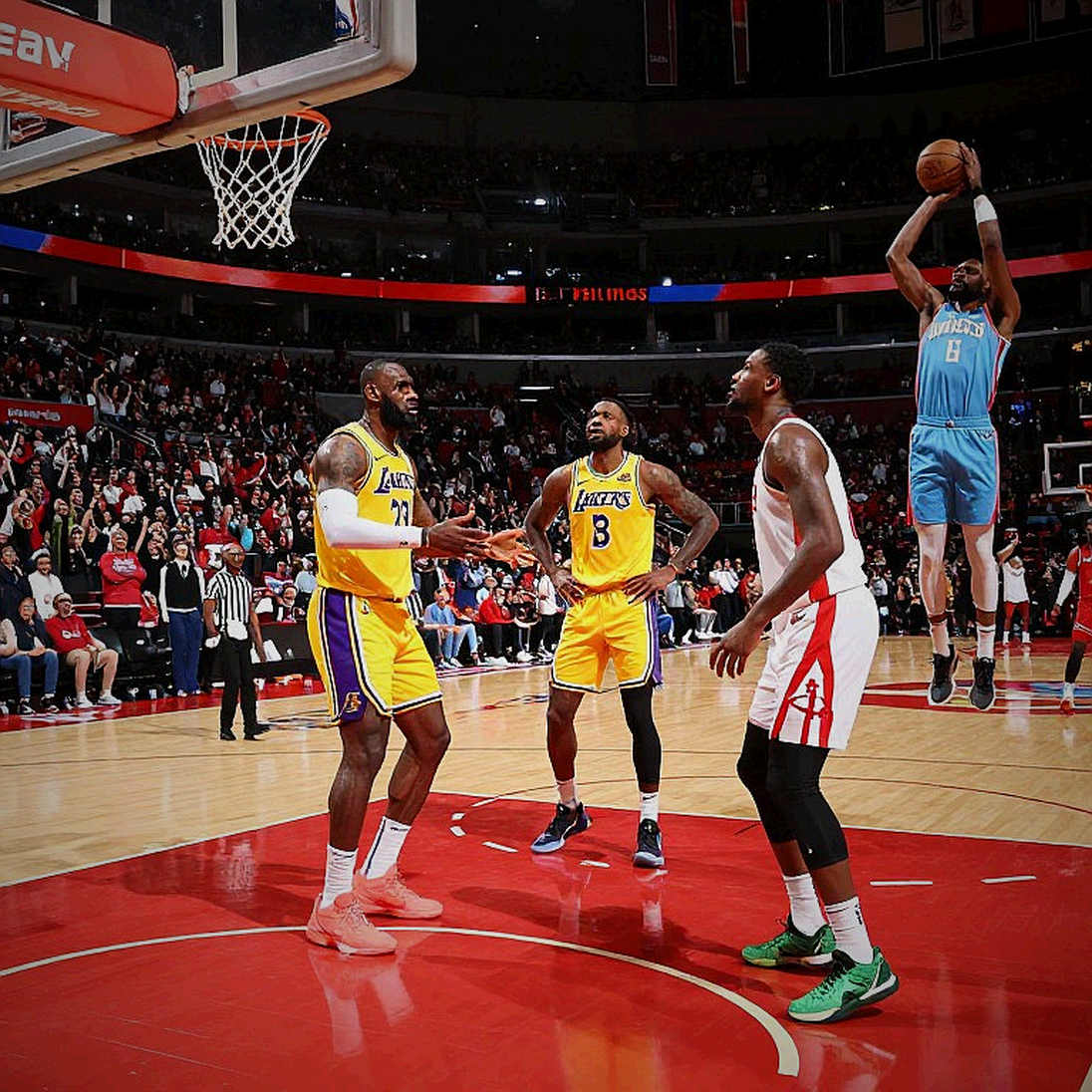
Ryan Nembhard is 23, entered the NBA undrafted, and averages 6.6 points and 5.3 assists in 19.5 minutes.
Three names, three entirely different trajectories. One is being paid for a future, one is being paid to leave, and one is being paid the minimum to prove he belongs.
I need to be explicit about data-collection conditions here. The core of the transaction comes from Shams Charania and ESPN, a tier-one source in the industry. But the secondary details, including exact contract figures, games played, and Atlanta's earlier moves, lack full attribution. By my own rule, they sit in the pending-verification pile, not the settled pile. Everything below is a roster-construction inference, not a performance projection.
The broader Atlanta picture across the same window also belongs on the table: a deal involving Kristaps Porzingis, the departure of Zaccharie Risacher, and the reappearance of Luguentz Dort. Those pieces carry low confidence in my data, so I will not build large conclusions on them. They are enough, though, to raise a question about direction.
Finney-Smith: what Atlanta bought, and what it did not
The 3-and-D wing archetype translates to playoff basketball better than most player types, because he does not need the ball to have value. Across a seven-game series, when every pass is studied down to the rhythm, a player only has to stand in the right corner, rotate on time, and not expose a gap on the other end to justify the contract.
Finney-Smith does that. He can guard both the three and the four, holds up switching in pick-and-roll coverage, and does not break the offensive structure because he does not demand the ball.
The problem lies elsewhere. He missed the first two months of the season while in Houston.
For a player at peak physical condition, two months is an incident. For a wing past his ascending phase, two months is a signal. And for a three-year contract still carrying full value, two months is a financial variable.
Based on my experience tracking games, I always split available data into two columns: the ability column and the availability column. The first tells you how good a player is when healthy. The second tells you what fraction of the season he stays healthy. In eight years of analysis, I have never come across a champion built entirely on the first column while leaving the second blank.
Atlanta is paying for the first column. It is betting the second column takes care of itself.
One technical detail deserves attention. The player option for 2028-29 creates a structurally elegant dilemma. If Finney-Smith is healthy and plays well, he declines the option, enters free agency, and Atlanta loses him for nothing. If he is hurt or declines, he exercises the option, and Atlanta carries the remaining money. Both branches tilt against the team to some degree. This is the kind of contract agents like and cap managers do not.
No shooting or defensive performance data for Finney-Smith appears in my source. No OffRtg, no DefRtg, no TS%, no lineup data. That means I can assess the contract structure, but not the on-court impact. Anyone speaking with certainty about the latter is talking past their data.
Hield: seven games is not decline, it is a tactical signal
Seven games.
That is the entirety of Buddy Hield's time in Atlanta. In a normal season, that amounts to under a tenth of the runway.
There are two ways to read the number. The first, popular on social media, is that Hield is finished. The second, and to my eye the correct one, is that Hield was deliberately removed from the plan.
A shooter does not lose the ability to shoot over a single summer. Shooting is the slowest-aging skill in basketball, because it depends on repeatable mechanics rather than vertical explosion. If Hield played only seven games, the likeliest explanation is that Atlanta's coaching staff decided his defensive limitations outweighed the spacing he creates.
That is a tactical decision, not a verdict on ability.
For Charlotte, the story shifts. The Hornets acquire a shooter who can open space for young players, a mid-to-low contract that is easy to move in a future deal, and a player option for 2027-28 worth just over $10 million. Two scenarios open up: keep Hield to teach young players off-ball movement, or move him again before the trade deadline.
In either scenario, the Hornets do not lose.
What is notable is that Hield belongs to the group of players the market misprices during trade season. When a player appears in seven games, his value on the news cycle falls below his value on the floor. That is the trough teams with strong data operations tend to mine. Charlotte, with cash attached, clearly read that trough.
Nembhard: the most valuable division in the deal
Nembhard is the easiest piece of the trade to overlook, and the one with the highest return on cost.
He averages 5.3 assists in 19.5 minutes. I like normalizing that to a 36-minute baseline to compare players with different workloads. Scaling 19.5 minutes to 36 uses a factor of roughly 1.85. Applied at that factor, Nembhard equates to about 12.2 points and 9.8 assists per 36 minutes.
Nearly 10 assists per 36 minutes is a genuine playmaking signal, not the product of a lucky handful of games.
There are limits to state clearly. Small sample. Undrafted origin. No turnover data, no shooting data, no defensive data. A guard who creates well but turns the ball over and cannot defend has no place in a playoff rotation. I have seen too many such cases across eight years tracking the VBA and the NBA to trust a single assist number.
But here is the crux: cost. A minimum contract for a 23-year-old guard with a good assist-per-minute rate is the lowest-risk purchase available on the market. Charlotte did not buy a star. Charlotte bought an option priced near zero.
If Nembhard develops, the Hornets have a cheap backup guard for years. If he does not, they lose almost nothing. In a market where teams will pay 100 million euros for a player who has not played 50 top-flight matches, this is the only kind of deal that still keeps its head.
The salary math: the part nobody tells
This is the section most news stories skip, and the one that determines whether the trade is even legal.
Atlanta sends out Hield at roughly $9.5 million plus Nembhard on an estimated minimum of about $1.2 million. Total outgoing salary lands near $10.7 million. Coming back is Finney-Smith at $17.7 million.
The gap is roughly $7 million.
If Atlanta sits below the first apron, salary-matching rules allow it to take back up to 125% of outgoing salary plus $100,000, or about $13.5 million. That figure is still about $4 million short of $17.7 million. The shortfall must be covered by cap space or a traded player exception generated by an earlier deal.
If Atlanta sits above the second apron, the picture becomes far more complicated, and the trade may require a third team in the middle.
We do not know which tier Atlanta occupies, because the source does not provide apron status for either team. That is a significant data gap, and I will not fill it with speculation.
The attached cash also needs to be understood correctly. Cash in NBA trades is subject to an annual limit and may absolutely not be used for salary matching. It is a sweetener. It does not close the roughly $4 million gap described above.
On pure market price, $17.7 million a year for a starting 3-and-D wing is fair, even slightly cheap if the player stays healthy. The price only becomes expensive when the availability column is left blank. Again, this trade was not decided by a salary figure. It was decided by a medical file.
The wider picture: two directions, two eras
When the arena is empty, I start hearing the sound of the game. I learned that in 2026, when leagues were suspended and I spent eight months rebuilding data from VBA replays across the 2026 and 2026 seasons. I split home and away performance to compare, and found that the loss of crowds affected free-throw rates for some players under 23, while barely touching older players.
The lesson was not the number itself. It was that the same data, placed in two different contexts, tells two different stories.
Applied here: Hield's seven games in Atlanta and another player's seven games in another context are not directly comparable facts.
Atlanta is choosing a direction. It swaps a shooter and a young guard for a defensive wing, accepts roughly $7 million more per season, and accepts a thicker injury file, in exchange for a clearer rotation. This is the move of a team that believes it can compete over the next two to three years, and believes what it lacks is not firepower but wing defense.
Charlotte is choosing another direction. It converts a long, heavy contract into a shooter who can be moved again, a 23-year-old guard with a strong assist rate, and cash. This is option accumulation, not contention.
Individual aura is paint; the system is the wall.
That is the line I have repeated to myself since the 2026 World Cup, when I refused to write about Messi to save my career, and Croatia taught me that the system is the star. In this trade, neither team bought a star. Both bought back their own structure.
Where I disagree with the crowd
The popular read on the forums is that Atlanta won this trade and Charlotte lost.
I disagree with both halves.
For Atlanta, what it bought is not defense. What it bought is the expectation of defense, packaged inside a three-year contract attached to a player who missed two months. If Finney-Smith plays enough games, this is a good deal. If he keeps missing time, Atlanta has converted a flexible salary into a negative asset, and to move it later it will need to attach a pick. That is the worst case, and it is not remote.
For Charlotte, the losing label rests on a false assumption: that a player's value equals his most recent game count. Seven games in Atlanta is data about usage plans, not about ability. The Hornets bought a shooter at the bottom of his market valuation cycle, plus a young guard with a near-10-assist-per-36 rate, plus cash. That is the structure of a safe trade, not a forced one.
The counterintuitive angle sits here: during trade season, noise follows the biggest name in the deal. But noise does not pay salaries. Payroll does. In this trade, the one paying is Atlanta, while the one holding options is Charlotte.
What to track
Emotion is the reporter; data is the referee.
The first variable is Finney-Smith's medical file through training camp and preseason. If he misses time there, Atlanta loses not only a defensive wing but the entire rationale of the trade.
The second variable is Charlotte's rotation in the first official game. If Hield comes off the bench for 18 to 22 minutes, the Hornets hold a sellable asset. If he draws a DNP-CD, a buyout enters the conversation within weeks.
The third variable is Nembhard's minutes, and whether his assist rate translates from the G League to the main floor.
In basketball, the final shot is decided 40 minutes earlier.
In this trade, the final shot was already decided during the first two months of the season in Houston, inside a treatment room none of us has data on.